MCQ
Which plot of $\ln \mathrm{k}$ vs $\frac{1}{\mathrm{~T}}$ is consistent with Arrhenius equation?
- A
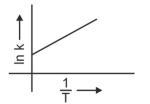
- B
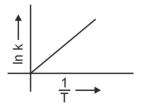
- ✓
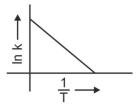
- D
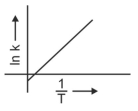
$ k=A e^{-\frac{E_a}{R T}} $
$ \therefore \quad \ln k=\ln A-\frac{E_a}{R T}$
In $\mathrm{kv} / \mathrm{s} \frac{1}{\mathrm{~T}}$ gives a straight line graph with slope $=-\frac{E_a}{R}$ and intercept $=\ln \mathrm{A}$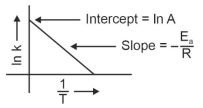
Generate a complete, print-ready paper with questions like this in minutes — across 16+ boards, with answer keys.
take place in two steps :
$(a)$ $Br^{-} + H^{+} + H_2O_2 \xrightarrow{{slow}} HOBr + H_2O$
$(b)$ $HOBr + Br^{-} + H^{+} \xrightarrow{{fast}} H_2O + Br_2$
The order of the reaction is

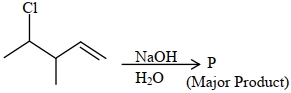
$C{H_2} = C{H_2}\xrightarrow{{HBr}}X\xrightarrow{{{\text{Hydrolysis}}}}Y\mathop {\xrightarrow{{N{a_2}C{O_3}}}}\limits_{{I_2}{\text{ excess}}} Z$
$E^o_{Fe^{3+} /Fe} = -0.036\,V,$ $E^o _{Fe^{2+} /Fe} = -0.439\,V$
The value of standard electrode potential for the change,
$Fe^{3+} (aq) + e^- \rightarrow Fe^{2+} (aq)$ will be ........ $V$.