Question
Which point on y-axis is equidistant from $(2, 3)$ and $(-4, 1)?$

Answer

$A(2, 3)$ and $B(-4, 1)$ are the given points.
Let $C(0, y)$ be the points are y-axis.
$\text{AC}=\sqrt{(0-2)^2+(\text{y}-3)^2}$
$\Rightarrow\ \text{AC}=\sqrt{4+\text{y}^2+9-6\text{y}}$
$\Rightarrow\ \text{AC}=\sqrt{\text{y}^2-6\text{y}+13}$
$\text{BC}=\sqrt{(0+4)^2+(\text{y}-1)^2}$
$\Rightarrow\ \text{BC}=\sqrt{16+\text{y}^2+1-2\text{y}}$
$\Rightarrow\ \text{BC}=\sqrt{\text{y}^2-2\text{y}+17}$
$ \text { Since } A C=B C $
$ A C^2=B C^2 $
$ y^2-6 y+13=y^2-2 y+17 $
$ \Rightarrow-6 y+2 y=17-13 $
$ \Rightarrow-4 y=4 $
$ \Rightarrow y=-1$
$\therefore$ The points on $y-$axis is $(0, -1).$

Need a full question paper?

Generate a complete, print-ready paper with questions like this in minutes — across 16+ boards, with answer keys.
Start Generating Free

Similar questions

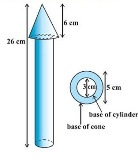
A wooden toy rocket is in the shape of a cone mounted on a cylinder as shown in given below figure. The height of the entire rocket is $26\ cm$, while the height of the conical part is $6 \ cm$. The base of the conical portion has a diameter of $5 \ cm,$ while the base diameter of the cylindrical portion is $3 \ cm.$ If the conical portion is to be painted orange and the cylindrical portion yellow, find the area of the rocket painted with each of these colours. $($Take $\pi  =3.14)$
If $4$ times the $4^{th}$ term of an $AP$ is equal to $18$ times its $18^{th}$ term then find its $22^{nd}$ term.
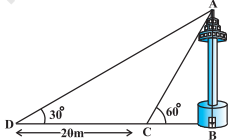
A $TV$ tower stands vertically on a bank of a canal. From a point on the other bank directly opposite the tower, the angle of elevation of the top of the tower is $60^{\circ}$. From another point $20 \ m$ away from this point on the line joing this point to the foot of the tower, the angle of elevation of the top of the tower is $30^{\circ}$. Find the height of the tower and the width of the canal.
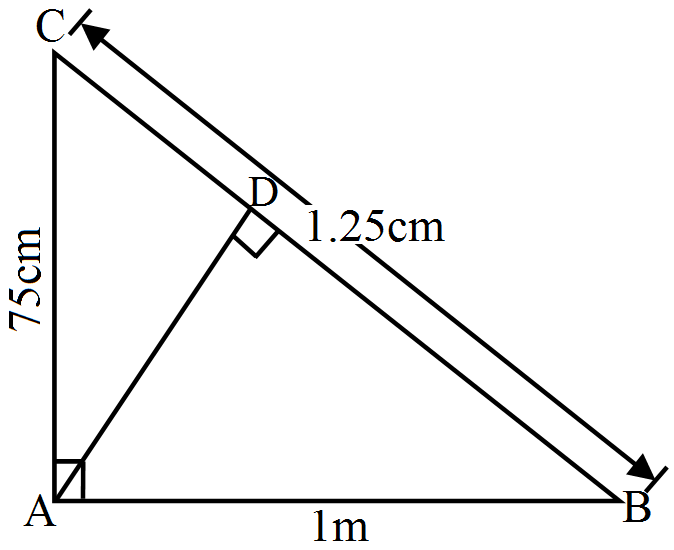
In a right angled triangle with sides $a$ and $b$ and hypotenuse $c$, the altitude drawn on the hypotenuse is $x.$ Prove that $ab = cx.$
Find the common difference and write the next four terms of the following arithmetic progressions:
$1, -2, -5, -8, .....$
Which term of the $AP \frac{5}{6},1,1\frac{1}{6},1\frac{1}{3},\ ...$ is $3?$
Solve the following quadratic equation:
$\sqrt3\text{x}^2-2\sqrt2\text{x}-2\sqrt3=0$
A piggy bank contains hundred $50$ p coins, fifty $₹\ 1$ coins, twenty $₹\ 2$ coins and ten $₹\ 5$ coins. If it is equally likely that one of the coins will fall out when the bank is turned upside down, what is the probability that the coin
  1. will be a $50$ p coin$?$
  2. will not be a $₹\ 5$ coin$?$
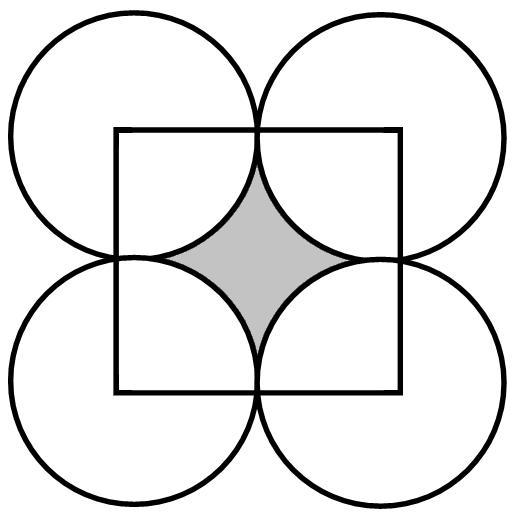
The diameter of a coin is $1\ cm ($in the following figure$).$ If four such coins be placed on a table so that the rim of each touches that of the other two, find the area of the shaded region $\big(\text{Take }\pi = 3.1416\big). $
In the given figure, $\angle\text{CAB}=90^\circ$ and $\text{AD}\perp\text{BC}.$ Show that $\triangle\text{BDA}\sim\triangle\text{BAC}.$ If $AC = 75\ cm, AB = 1m,$ and $BC = 1,25m$ find $AD.$