MCQ
Which polymer among the following does not soften on heating?
  • Bakelite
  • B
    Polythene
  • C
    Polystyrene
  • D
    $\text{PVC}$

Answer

Correct option: A.
Bakelite
Bakelite is a highly cross$-$linked thermosetting polymer. It does not soften on heating because it is heat resistant in nature. Remaining other polymers are thermoplastics which gets soften on heating.

Need a full question paper?

Generate a complete, print-ready paper with questions like this in minutes — across 16+ boards, with answer keys.
Start Generating Free

Similar questions

$HI$ cannot be prepared by the action of conc. ${H_2}S{O_4}$ on $KI$ because
Which does not react with Fehling solution
Ethanedial has which functional group(s)
When initial concentration of a reactant is doubled in a reaction, its half-life period is not affected. The order of the reaction is
Ceric ammonium nitrate and $CHCl _{3} /$ alc. $KOH$ are used for the identification of functional groups present in ...... and ........ respectively.
$KClO _3+6 FeSO _4+3 H _2 SO _4 \rightarrow KCl +3 Fe _2\left( SO _4\right)_3+3 H _2 O$ The above reaction was studied at $300\,K$ by monitoring the concentration of $FeSO _4$ in which initial concentration was $10\,M$ and after half an hour became $8.8\,M$. The rate of production of $Fe _2\left( SO _4\right)_3$ is $........\times 10^{-6}\,mol\,L ^{-1}\,s ^{-1}$.
The rate constant is given by the equation $k = pz{e^{ - E/RT}}$. Which factor should register a decrease for the reaction to proceed more rapidly
In ammonium-phosphomolybdate, the oxidation state of Mo is ${ }^{+}$ $..........$.
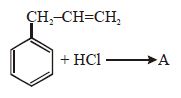
What is $'A'$ in the following reaction
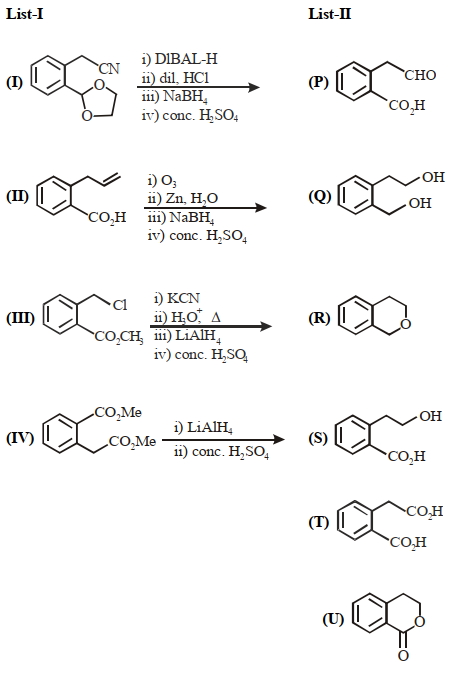
Answer the following by appropriately matching the lists based on the information given in the paragraph $List-I$ includess starting materials and reagents of selected chemical reactions. $List-II$ gives structures of compounds that may be formed as intermediate products and/or final products from the reactions of $List-I$

($1$) Which of the following options has correct combination considering $List-I$ and $List-II$?

$(1) (III), (S), (R)$ $(2) (IV), (Q), (R)$ $(3) (III), (T), (U)$ $(4) (IV), (Q), (U)$

($2$) Which of the following options has correct combination considering $List-I$ and $List-II$?

$(1) (I), (Q), (T), (U)$ $(2) (II), (P), (S), (U)$ $(3) (II), (P), (S), (T)$ $(4) (I), (S), (Q), (R)$

Give the answer quetion ($1$) and ($2$)