MCQ
Which process converts olefins into parafins
- AHalogenation
- BDehydration
- ✓Hydrogenation
- DHydrolysis

Generate a complete, print-ready paper with questions like this in minutes — across 16+ boards, with answer keys.
(Image)
The frequency of the wave is $\mathrm{x} \times 10^{19} \mathrm{~Hz}$. $x=$ . . . . (nearest integer)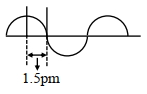
$\mathrm{C}_6 \mathrm{H}_6(1)+\frac{15}{2} \mathrm{O}_2(\mathrm{~g}) \rightarrow \mathrm{CO}_2(\mathrm{~g})+3 \mathrm{H}_2 \mathrm{O}(1) \text {. }$
The standard enthalpy of combustion of $2 \mathrm{~mol}$ of benzene is - ' $x$ ' $k J$.
$\mathrm{x}=$. . . . . . . . . .
$(1)$ standard Enthalpy of formation of $1 \mathrm{~mol}$ of $\mathrm{C}_6 \mathrm{H}_6(1)$, for the reaction $6 \mathrm{C}$ (graphite) $+3 \mathrm{H}_2(\mathrm{~g}) \rightarrow \mathrm{C}_6 \mathrm{H}_n(1)$ is $48.5 \mathrm{~kJ} \mathrm{~mol}^{-1}$.
$(2)$ Standard Enthalpy of formation of $1 \mathrm{~mol}$ of $\mathrm{CO}_2(\mathrm{~g})$, for the reaction $\mathrm{C}$ (graphite) $+\mathrm{O}_{2(\mathrm{~g})} \rightarrow \mathrm{CO}_2(\mathrm{~g})$ is $-393.5 \mathrm{~kJ} \mathrm{~mol}^{-1}$.
$(3)$ Standard and Enthalpy of formation of $1 \mathrm{~mol}$ of $\mathrm{H}_2 \mathrm{O}(1)$, for the reaction $\mathrm{H}_2(\mathrm{~g})+\frac{1}{2} \mathrm{O}_2(\mathrm{~g}) \rightarrow \mathrm{H}_2 \mathrm{O}(1)$ is $-286 \mathrm{~kJ} \mathrm{~mol}^{-1}$.