MCQ
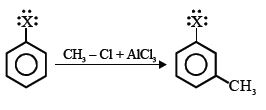
Which reaction show correct major product?
- A
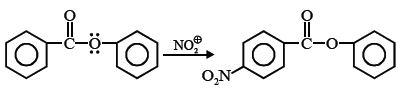
- B
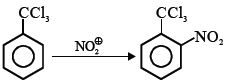
- ✓
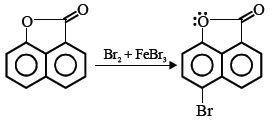
- D
Generate a complete, print-ready paper with questions like this in minutes — across 16+ boards, with answer keys.
Assertion $(A)$ : Haloalkanes react with $\mathrm{KCN}$ to form alkyl cyanides as a main product while with $\mathrm{AgCN}$ form isocyanide as the main product.
Reason $(R)$ : $\mathrm{KCN}$ and $\mathrm{AgCN}$ both are highly ionic compounds.
In the light of the above statement, choose the most appropriate answer from the options given below:
$(I)$ $\begin{array}{*{20}{c}} {C{H_3}\,\,\,\,\,\,Br} \\ {|\,\,\,\,\,\,\,\,\,\,\,\,\,\,\,\,|\,\,} \\ {C{H_3} - CH - CH - C{H_3}} \end{array}$
$(II)$ $[Figure\,2]$
$(III)$ $\begin{array}{*{20}{c}} {{C_6}{H_5} - CH - {C_6}{H_5}} \\ {|\,\,\,} \\ {Br} \end{array}$
$(IV)$ $[Figure\,4]$
Which one of the following is correct sequence of the halides given above in the decreasing order of their reactivity ?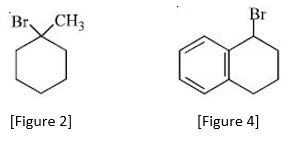
$(A)$ tert-butanol and $2$-methylpropan-$2$-ol
$(B)$ tert-butanol and $1$, $1$-dimethylethan-$1$-ol
$(C)$ $n$-butanol and butan-$1$-ol
$(D)$ isobutyl alcohol and $2$-methylpropan-$1$-ol
(image) $\mathop {\xrightarrow{{CHC{l_3}/KOH}}}\limits_{heat} $ Intermediate $\mathop {\xrightarrow{{HCl}}}\limits_{300\,K} $ $X$