MCQ
Which reagent is useful in converting $1-$ butanol to $1-$ bromobutane
  • A
    $CHB{r_3}$
  • B
    $B{r_2}$
  • C
    $C{H_3}Br$
  • $PB{r_3}$

Answer

Correct option: D.
$PB{r_3}$
d
(d) $3C{H_3}C{H_2}C{H_2}C{H_2} - OH + PB{r_3} \to $

       $3C{H_3}C{H_2}C{H_2}C{H_2} - Br + {H_3}P{O_3}$

Need a full question paper?

Generate a complete, print-ready paper with questions like this in minutes — across 16+ boards, with answer keys.

Start Generating Free

Similar questions

A mixture containing primary, secondary and tertiary amine is treated with diethyl oxalate. Choose the correct statement:
The process of passing of a precipitate into colloidal solution on adding an electrolyte is called:
When ethyl amine is heated with chloroform and alcoholic $ KOH$ , a compound with offensive smell is obtained. This compound is
Match List $I$ with List $II$

  List $I$   List $II$
$A$ $\alpha$-Glucose and $\alpha-$Galactose $I$ Functional isomers
$B$ $\alpha$-Glucose and $\beta-$-Galactose $II$ Homologous
$C$ $\alpha$-Glucose and $\alpha$-Galactose $III$ Anomers
$D$ $\alpha$-Glucose and $\alpha$-Galactose $IV$ Epimers

Choose the correct answer from the options given below:

How many gram of $KCl$ would have to be dissolved in $60\, g$ $H_2O$ to give $20\%$ by weight of solution .......... $gm$.
A $0.6\%$  solution of urea (molecular weight $ = 60 $) would be isotonic with
In the following reaction sequence The compound $I$ is

$\mathop I\limits_{({C_3}{H_6}C{l_2})} \xrightarrow{{KOH(aq)}}II\xrightarrow[{(ii){H_2}O/{H^ + }}]{{(i)C{H_3}MgBr}}III\xrightarrow{{Anhy.ZnC{l_2} + Conc.HCl}}$ given turbidity immediately
Equivalent conductance of an electrolyte containing $NaF$ at infinite dilution is $90.1\,
Ohm^{-1}\,cm^2$. If $NaF$ is replaced by $KF$ what is the value of equivalent conductance? ........... $\mathrm{Ohm}^{-1}\, \mathrm{cm}^{2}$
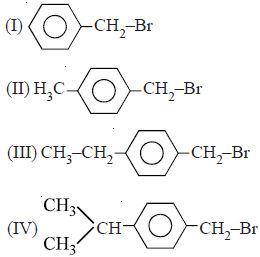
Arrange the following compounds in order of decreasing rate of hydrolysis for $S_{N^{1}}$ reaction :
Among $V ( CO )_6, Cr ( CO )_5, Cu ( CO )_3, Mn ( CO )_5, Fe ( CO )_5,\left[ Co ( CO )_3\right]^{3-},\left[ Cr ( CO )_4\right]^{4-}$, and $\operatorname{Ir}( CO )_3$, the total number of species isoelectronic with $Ni ( CO )_4$ is. . . . . [Given atomic number : $V =23, Cr ,=24, Mn =25, Fe =26, Co =27, Ni =28, Cu =29, Ir =77$ ]