MCQ
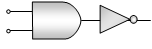
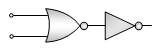
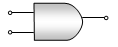
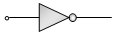
Which represents NAND gate 
 
  • B
  • C
  • D

Answer

Correct option: A.

Need a full question paper?

Generate a complete, print-ready paper with questions like this in minutes — across 16+ boards, with answer keys.

Start Generating Free

Similar questions

The sun is rotating about its own axis. The spectral lines emitted from the two ends of its equator, for an observer on the earth, will show
A radioactive sample is $\alpha$-emitter with half life $138.6$ days is observed by a student to have $2000$ disintegration/sec. The number of radioactive nuclei for given activity are
A concave mirror is used to focus the image of a flower on a nearby well $120cm$ from the flower. If a lateral magnification of $16$ is desired, the distance of the flower from the mirror should be.....$cm$
In Young's double slit interference experiment , the slit widths are in the ratio $1 : 25$. Then the ratio of intensity at the maxima and minima in the interference pattern is
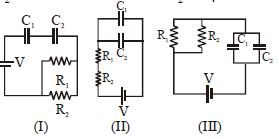
Given,

${R_1} = 1\,\Omega $                     $C_1 \,= 2\,\mu F$

${R_2} = 2\,\Omega $                     $C_2 \,= 4\,\mu F$

The time constants ( in $\mu\, s$) for the circuits $I, II, III$ are respectively
The magnitude of the de-Broglie wavelength $(\lambda)$ of electron $(e)$, proton $(p)$, neutron $(n)$ and $\alpha-$ particle $(\alpha)$ all having the same energy of $1\,MeV$, in the increasing order will follow the sequence
Out of the following waves of the Sun, the wave which is used as an electrical energy is:
The angle of dip at a place on the earth gives
If the critical angle for total internal reflection from a medium to vacuum is $30^{\circ}$, the velocity of light in the medium is
Two solenoids have identical geometrical construction and same number of truns but  one is made of thick wire and other of thin wire. Which of the following quantities are  different for two solenoids :- 
$(a)$ Self inductance.
$(b)$ Rate of joule heating if the same current goes through them.
$(c)$ Magnetic potential energy if the same current goes through them .
$(d)$ Time constant.