MCQ
Which responds to $+ve$ iodoform test ?
  • A
    Butanol
  • B
    Butan$-1-$al
  • Butanol$-2$
  • D
    $3-$pentanone

Answer

Correct option: C.
Butanol$-2$
c
$\mathop {\begin{array}{*{20}{c}}
  {\,\,\,\,\,\,\,\,\,\,\,\,\,\,\,\,\,\,\,\,OH} \\ 
  {\,\,\,\,\,\,\,\,\,\,\,\,\,\,\,|} \\ 
  {C{H_3} - C{H_2} - CH - C{H_3}} 
\end{array}}\limits_{{\text{2}}\,\,{\text{butanol}}} $ contain ${\begin{array}{*{20}{c}}
  {\,\,\,\,\,\,\,\,\,\,\,\,\,\,\,\,OH\,\,} \\ 
  {\,\,\,\,\,\,\,\,\,\,\,\,\,|\,\,\,} \\ 
  {C{H_3} - CH - } 
\end{array}}$

group by which it give $+ve$ iodoform test.

Need a full question paper?

Generate a complete, print-ready paper with questions like this in minutes — across 16+ boards, with answer keys.

Start Generating Free

Similar questions

Phosgene is the common name of
The ether that undergoes electrophilic substitution reactions is
The acidity of alpha hydrogen of the carbonyl group is due to:
Assertion : $4-$ Nitrochlorobenzene undergoes nucleophilic substitution more readily than chlorobenzene.
Reason : Chlorobenzene undergoes nucleophilic substitution by elimination-addition mechanism while $4-$ nitrochlorobenzene undergoes nucleophilic substitution by addition-elimination mechanism.
For a spontaneous reaction the $\Delta G,$ equilibrium constant $ (K)$ and $E_{Cell}^o$ will be respectively
The relative reactivity of $1\,^oH, 2\,^oH$ and $3\,^oH$ in bromination reaction has been found to be $1 : 82 : 1600$ respectively. In the reaction

$\begin{array}{*{20}{c}}
  {C{H_3}\,\,\,\,\,\,\,\,\,\,\,\,\,\,\,\,\,\,\,\,\,\,\,\,\,\,\,\,\,\,\,\,\,\,\,\,\,\,\,\,\,\,\,} \\ 
  {|\,\,\,\,\,\,\,\,\,\,\,\,\,\,\,\,\,\,\,\,\,\,\,\,\,\,\,\,\,\,\,\,\,\,\,\,\,\,\,\,\,\,\,\,\,\,\,\,\,} \\ 
  {C{H_3} - CH - C{H_3}(excess) + B{r_2}\xrightarrow{{hv}}} 
\end{array}$ $\mathop {\begin{array}{*{20}{c}}
  {\,\,\,\,\,C{H_3}} \\ 
  | \\ 
  {C{H_3} - C - C{H_3}} \\ 
  | \\ 
  {\,\,Br} 
\end{array}}\limits_{(A)} $   +   $\mathop {\begin{array}{*{20}{c}}
  {C{H_3}\,\,\,\,\,\,\,\,\,\,} \\ 
  {\,\,|\,\,\,\,\,\,\,\,\,\,\,\,\,\,\,\,\,\,\,} \\ 
  {C{H_3} - CH - C{H_2} - Br} 
\end{array}}\limits_{(B)} $ 

the percentage yields of the products $(A)$ and $(B)$ are expected to be
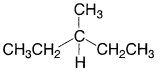
The maximum number of isomers (including stereoisomers) that are possible on monochlorination of the following compound, is
The prosthetic group present in nucleoproteins is:
Aldehydes are isomeric with
For the elementary reaction $M \rightarrow N$, the rate of disappearance of $M$ increases by a factor of $8$ upon doubling the concentration of $M$. The order of the reaction with respect to $M$ is :