Question
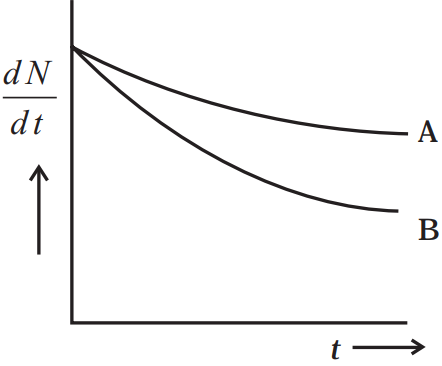
Which sample, A or B shown in Fig. has shorter mean-life?

Answer

B has shorter mean life as $\lambda$ is greater for B. This can be explained mathematically as given below
From the given graph, at $\text{t}=0,\Big(\frac{\text{dN}}{\text{dt}}\Big)_\text{A}=\Big(\frac{\text{dN}}{\text{dt}}\Big)_\text{B}\Rightarrow\ (\text{N}_0)_\text{A}=(\text{N}_0)_\text{B}$
Considering any instant t by drawing a line perpendicular to time axis, we find that $\Big(\frac{\text{dN}}{\text{dt}}\Big)_\text{A}>\Big(\frac{\text{dN}}{\text{dt}}\Big)_\text{B}$
$\Rightarrow\ \lambda_\text{A}\text{N}_\text{A}>\lambda_\text{B}\text{N}_\text{B}$
$\because\ \text{N}_\text{A}>\text{N}_\text{B}$ (rate of decay of B is slower)
$\because\ \lambda_\text{B}>\lambda_\text{A}$
As, average life, $\tau=\frac{1}{\lambda}$
$\Rightarrow\ \tau_\text{A}>\tau_\text{B}$

Need a full question paper?

Generate a complete, print-ready paper with questions like this in minutes — across 16+ boards, with answer keys.

Start Generating Free

Similar questions

  1. What characteristic property of nuclear force explains the constancy of binding energy per nucleon (BE/A) in the range of mass number 'A' lying 30 <A < 170?
  2. Show that the density of nucleus over a wide range of nuclei is constantindependent of mass numberA.
For the potentiometer circuit shown in the given figure, points X and Y represent the two terminals of an unknown emf E'. A student observed that when the jockey is moved from the end A to the end B of the potentiometer wire, the deflection in the galvanometer remains in the same direction.
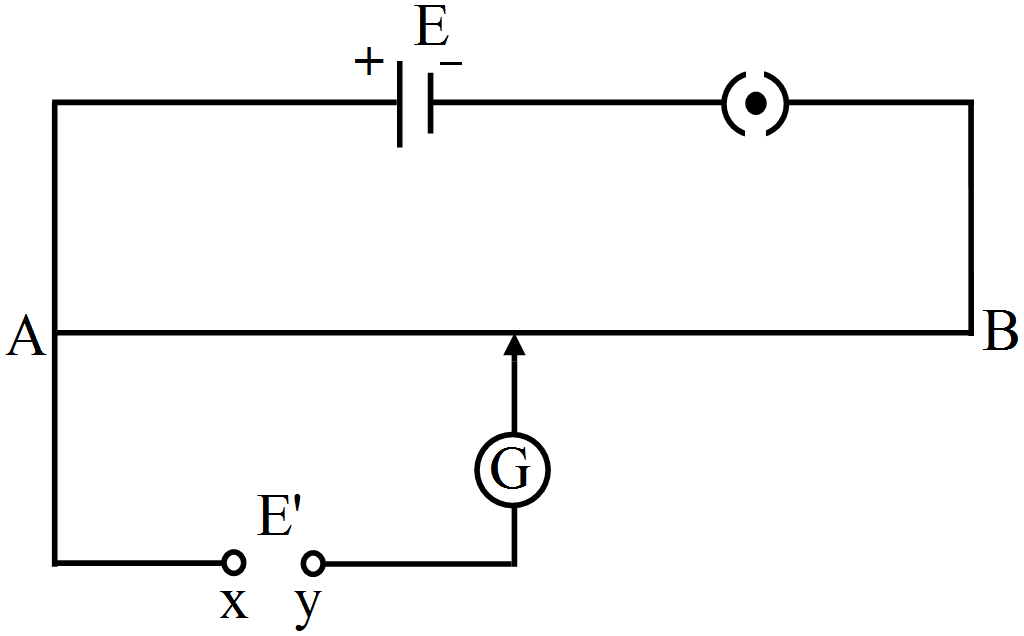
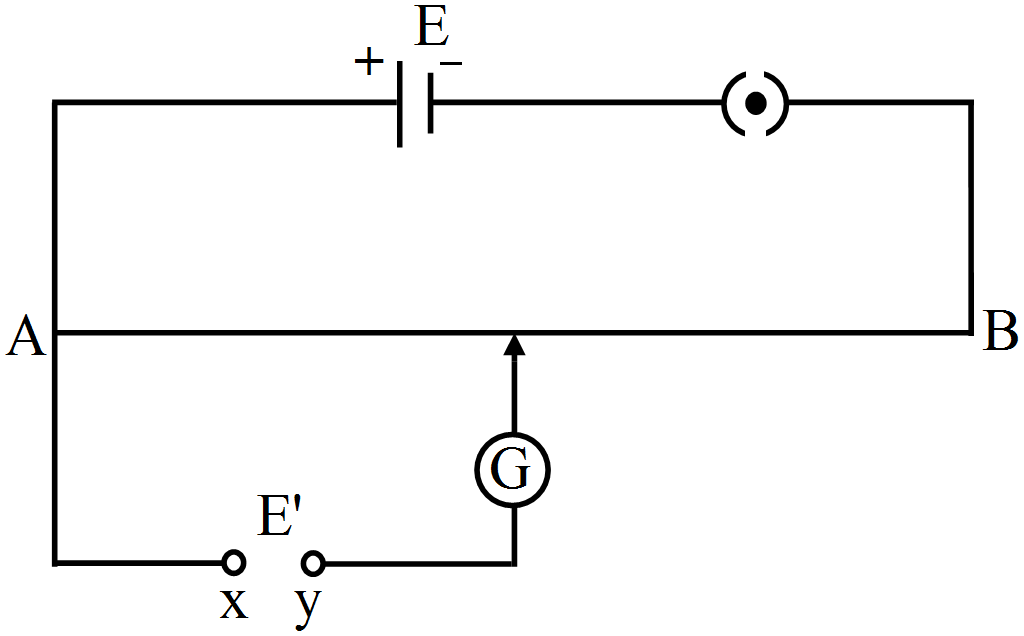
What may be the two possible faults in the circuit that could result in this observation?

If the galvanometer deflection at the end B is (i) more, (ii) less than at the end A, which of the two faults, listed above, would be there in the circuit? Give reason in support of your answer in each case.
The normal body-temperature of a person is 97°F. Calculate the rate at which heat is flowing out of his body through the clothes assuming the following values. Room temperature = 47°F, surface of the body under clothes= 1.6m2, conductivity of the cloth $= 0.04\text{Js}^{-1}\text{m}^{-1}{^{\circ}}\text{C}^{-1},$ thickness of the cloth = 0.5cm.
Suppose white light falls on a double slit but one slit is covered by a violet filter (allowing $\lambda=400\text{nm}$). Describe the nature of the fringe pattern observed.
Consider the situation of the previous question from a frame moving with a speed v0 parallel to the initial velocity of the block.
  1. What are the initial and final kinetic energies?
  2. What is the work done by the kinetic friction?
A circular coil of radius 8 cm and 20 turns is rotated about its vertical diameter with an angular speed of $50 rad s ^{-1}$ in a uniform horizontal magnetic field of magnitude $3 \times 10^{-2} T$. Obtain the maximum and average emf induced in the coil. If the coil forms a closed loop of resistance $10 \Omega$, calculate the maximum value of current in the coil.
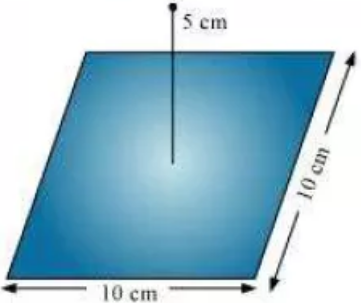
A point charge +10 μC is a distance 5cm directly above the centre of a square of side 10cm, as shown in Fig. 1.34. What is the magnitude of the electric flux through the square?
(Hint: Think of the square as one face of a cube with edge 10cm.)

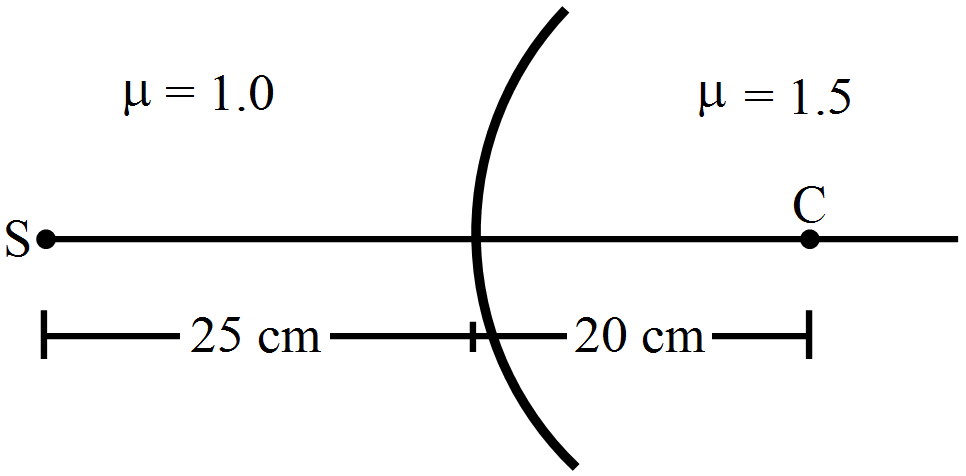
Locate the image formed by refraction in the situation shown in figure.

What is the de Broglie wavelength associated with (a) an electron moving with a speed of $5.4 \times 10^6 m / s$, and (b) a ball of mass $150 g$ travelling at $30.0 m / s$ ?
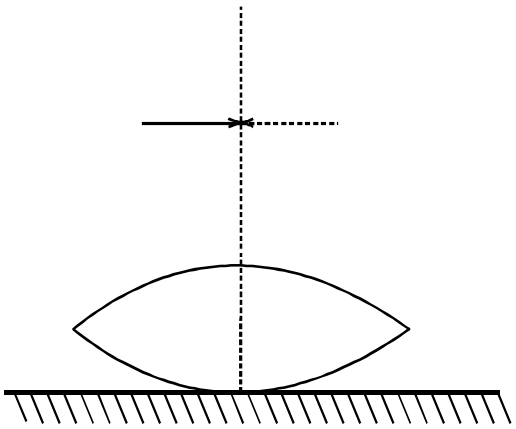
A symmetric biconvex lens of radius of curvature R and made of glass of refractive index 1·5, is placed on a layer of liquid placed on top of a plane mirror as shown in the figure. An optical needle with its tip on the principal axis of the lens is moved along the axis until its real, inverted image coincides with the needle itself. The distance of the needle from the lens is measured to be x. On removing the liquid layer and repeating the experiment, the distance is found to be y. Obtain the expression for the refractive index of the liquid in terms of x and y.