MCQ
Which sample contains the largest number of atoms ?
- A$1\, mg$ of $C_4H_{10}$
- B$1\, mg$ of $N_2$
- C$1\, mg$ of $Na$
- ✓$1\, ml$ of $H_2O$
$1 \mathrm{mg}$ of $N_{2}=\frac{2 N \times 10^{-3}}{28}$ atoms
$1 \mathrm{mg}$ of $N a=\frac{N \times 10^{-3}}{23}$ atoms
$1 \mathrm{mL}=1 \mathrm{g} H_{2} O=\frac{3 N}{18}$ atoms
Generate a complete, print-ready paper with questions like this in minutes — across 16+ boards, with answer keys.
$A$. Compound ' $B$ ' is aromatic
$B$. The completion of above reaction is very slow
$C$. '$A$' shows tautomerism
$D$. The bond lengths $C - C$ in compound $B$ are found to be same
Choose the correct answer from the options given below :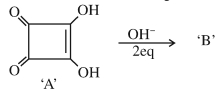
$\begin{array}{*{20}{c}}
{C{H_3}\,\,\,\,\,\,\,\,\,\,\,\,\,\,\,\,\,\,\,\,\,\,\,\,\,\,\,\,\,\,\,\,C{H_3}\,\,\,\,\,\,\,} \\
{|\,\,\,\,\,\,\,\,\,\,\,\,\,\,\,\,\,\,\,\,\,\,\,\,\,\,\,\,\,\,\,\,\,\,\,\,\,\,\,\,\,|\,\,\,\,\,\,\,\,\,\,\,\,} \\
{\mathop C\limits_7 {H_3} - \mathop C\limits_6 - \mathop C\limits_5 H = \mathop C\limits_4 H - \mathop C\limits_3 H - \mathop C\limits_2 \equiv \mathop C\limits_1 H} \\
{|\,\,\,\,\,\,\,\,\,\,\,\,\,\,\,\,\,\,\,\,\,\,\,\,\,\,\,\,\,\,\,\,\,\,\,\,\,\,\,\,\,\,\,\,\,\,\,\,\,\,\,\,\,\,} \\
{C{H_3}\,\,\,\,\,\,\,\,\,\,\,\,\,\,\,\,\,\,\,\,\,\,\,\,\,\,\,\,\,\,\,\,\,\,\,\,\,\,\,\,\,\,\,\,\,\,\,}
\end{array}$
is in the following sequence