MCQ
Which scientist discovered the neutron?
- ARutherford
- BFermi
- ✓Chadwick
- DPoly
Generate a complete, print-ready paper with questions like this in minutes — across 16+ boards, with answer keys.
A triangular loop of side l carries a current I. It is placed in a magnetic field B such that the plane of the loop is in the direction of B. The torque on the loop is
|
(a) Zero |
(b) IBl |
(c) |
(d) |
Assertion : Silicon is preferred over germanium for making semiconductor devices.
Reason : The energy gap for germanium is more than the energy gap of silicon.
|
(a) If both assertion and reason are true and the reason is the correct explanation of the assertion. |
|
(b) If both assertion and reason are true but reason is not the correct explanation of the assertion. |
|
(c) If assertion is true but reason is false. |
|
(d) If the assertion and reason both are false. |
A current of two amperes is flowing through a cell of e.m.f. 5 volts and internal resistance 0.5 ohm from negative to positive electrode. If the potential of negative electrode is 10V, the potential of positive electrode will be
|
(a) 5 V |
(b) 14 V |
(c) 15 V |
(d) 16 V |
Between the plates of a parallel plate condenser, a plate of thickness  and dielectric constant
  is placed. In the rest of the space, there is another plate of thickness
  and dielectric constant
  . The potential difference across the condenser will be
|
(a) |
(b) |
(c) |
(d) |
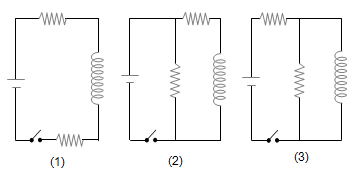
The figure shows three circuits with identical batteries, inductors, and resistors. Rank the circuits according to the current through the battery (i) just after the switch is closed and (ii) a long time later, greatest first
|
(a) (i) |
|
(b) (i) |
|
(c) (i) |
|
(d) (i) |
A circular coil of 500 turns of wire has an enclosed area of  per turn. It is kept perpendicular to a magnetic field of induction 0.2 T and rotated by 180° about a diameter perpendicular to the field in 0.1 sec. How much charge will pass when the coil is connected to a galvanometer with a combined resistance of 50 ohms
|
(a) 0.2 C |
(b) 0.4 C |
(c) 2 C |
(d) 4 C |