MCQ
Which scientist proposed the concept of atomic mass?
- AAvogadro
- BGay Lussac
- CProust
- DDalton
Explanation:
The concept of atomic mass was proposed by William Prout. Early atomic mass theory was proposed by the English chemist William Prout in a series of published papers in 1815 and 1816. Known as Prout's Law, Prout suggested that the known elements had atomic weights that were whole number multiples of the atomic mass of hydrogen.
Generate a complete, print-ready paper with questions like this in minutes — across 16+ boards, with answer keys.
The work function of aluminium is 4.2 eV. If two photons, each of energy 3.5 eV strike an electron of aluminium, then emission of electrons will be
|
(a) Possible |
|
(b) Not possible |
|
(c) Data is incomplete |
|
(d) Depend upon the density of the surface |
The ratio of longest wavelength and the shortest wavelength observed in the five spectral series of emission spectrum of hydrogen is
|
(a) |
(b) |
(c) 25 |
(d) |
A ray of light is incident on a transparent glass slab of refractive index 1.62. The reflected and the refracted rays are mutually perpendicular. The angle of incidence is
|
(a) 58.3o |
(b) 50o |
(c) 35o |
(d) 30o |
A gate has the following truth table
|
P |
1 |
1 |
0 |
0 |
|
Q |
1 |
0 |
1 |
0 |
|
R |
1 |
0 |
0 |
0 |
The gate is
|
(a) NOR |
(b) OR |
(c) NAND |
(d) AND |
In the circuit shown in figure reading of voltmeter is V1 when only S1 is closed, reading of voltmeter is V2 when only S2 is closed and reading of voltmeter is V3 when both S1 and S2 are closed. Then
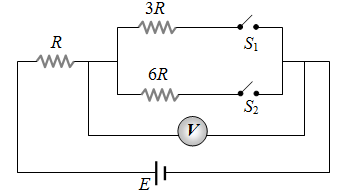
|
(a) V3 > V2 > V1 |
(b) V2 > V1 > V3 |
(c) V3 > V1 > V2 |
(d) V1 > V2 > V3 |


