MCQ
Which statement is incorrect in respect of the above reaction ?
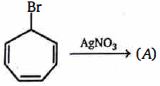
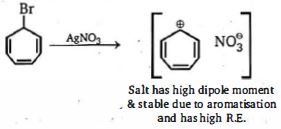
- AProduct is aromatic
- BProduct has high dipole moment
- ✓Product has less resonance energy
- DProduct is soluble in polar solvent
Generate a complete, print-ready paper with questions like this in minutes — across 16+ boards, with answer keys.
| List $I$ Oxide | List $II$ Type of Bond |
| $A$ $N _2 O _4$ | $I$. $1 N = O$ bond |
| $B$ $NO _2$ | $II$. $1 N - O - N$ bond |
| $C$ $N _2 O _5$ | $III$. $1 N - N$ bond |
| $D$ $N _2 O$ | $IV$. $1 N = N / N \equiv N$ bond |
Choose the correct answer from the options given below:
Cell notation : $M \left|\underset{0.01}{ M ^{2+}} \| \underset{0.0001}{ M ^{2+}}\right| M$
.........$V$ value of $E _{ Cell }^{o}$ is $4$ volt (Given $\frac{ RT }{ F }$ in $10=0.06$ )
The product $B$ is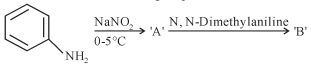
$\mathrm{A}(\mathrm{g}) \rightarrow 2 \mathrm{~B}(\mathrm{~g})+\mathrm{C}(\mathrm{g})$
If the total pressure of the gases is found to be $200$ torr after $23 \mathrm{sec}$. and $300$ torr upon the complete decomposition of $\mathrm{A}$ after a very long time, then the rate constant of the given reaction is . . . . . .$\times 10^{-2} \mathrm{~s}^{-1}$ (nearest integer)
[Given : $\log _{10}(2)=0.301$ ]