MCQ
Which statement is wrong
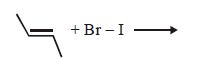
  • A
    Two products are formed in this reaction
  • B
    This reaction is an example of anti-addition reaction
  • This reaction has cyclic bromonium ion intermediate
  • D
    The formed products will have enantiomeric relationship

Answer

Correct option: C.
This reaction has cyclic bromonium ion intermediate
c

Need a full question paper?

Generate a complete, print-ready paper with questions like this in minutes — across 16+ boards, with answer keys.

Start Generating Free

Similar questions

Which of the following properties of the alkaline earth metals increase from $Be$ to $Ba$?

$(i)$ Atomic radius $(ii)$ Ionisation energy $(iii)$ Nuclear charge

Geometrical isomers differ in
Match List$-I$ with List$-II :$

List$-I$ List$-II$
$(a)$ $\mathrm{NaOH}$ $(i)$ Acidic
$(b)$ $\mathrm{Be}(\mathrm{OH})_{2}$ $(ii)$ Basic
$(c)$ $\mathrm{Ca}(\mathrm{OH})_{2}$

$(iii)$ Amphoteric

$(d)$ $\mathrm{B}(\mathrm{OH})_{3}$  
$(e)$ $\mathrm{Al}(\mathrm{OH})_{3}$  

Choose the most appropriate answer from the option given below :

The relative atomic mass of naturally occurring chlorine is not a whole number. What is the reason for this ?
Which is the 1st organic compound synthesized in lab?
In which of the following reactions does the heat change represent the heat of formation of water
Thermal decomposition of $AgNO _3$ produces two paramagnetic gases. The total number of electrons present in the antibonding molecular orbitals of the gas that has the higher number of unpaired electrons is. . . . .
Maximum bond angle is present in
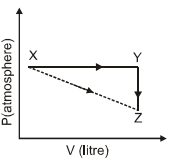
For an ideal gas, consider only $P - V$ work in going from an initial state $X$ to the final stat $Z$. The final state $Z$ can be reached by either of the two paths shown in the figure. Which of the following choice$(s)$ is (are) correct? [take $\Delta S$ as change in entropy and w as work done].

$(A)$ $\Delta S _{ x \rightarrow z}=\Delta S _{ x \rightarrow y}+\Delta S _{ y \rightarrow z}$

$(B)$ $w_{x \rightarrow z}=w_{x \rightarrow y}+w_{y \rightarrow z}$

$(C)$ $w_{x \rightarrow z \rightarrow z}=w_{x \rightarrow y}$

$(D)$ $\Delta S _{x \rightarrow y \rightarrow z}=\Delta S _{x \rightarrow y}$
According to the periodic law of elements, the variation in properties of elements is related to their