Question
Which term of the $AP\ 72, 68, 64, 60, .....$ is $0?$

Answer

In the given $AP,$ we have $a =72$ and $d = 68 - 72 = -4$
Suppose there are $n$ terms in given $AP,$ we have
$T_n= 0 ⇒ a + (n - 1)d = 0 $
$⇒ 72 + (n - 1)(-4) = 0$
$⇒ 72 - 4n + 4 = 0$
$⇒ 4n = 76 ⇒ n = 19$
Hence, the $19^{th}$  term in the given $AP$ is $0.$

Need a full question paper?

Generate a complete, print-ready paper with questions like this in minutes — across 16+ boards, with answer keys.
Start Generating Free

Similar questions

Find the coordinates of the point where the diagonals of the parallelogram formed by joining the points $(-2, -1), (1, 0), (4, 3)$ and $(1, 2)$ meet.
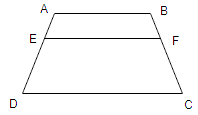
$ABCD$ is a trapezium with $AB || DC. E$ and $F$ are two points on non-parallel sides $AD$ and $BC$ respectively, such that $EF$ is parallel to $AB.$ Show that $\frac{AE}{ED}=\frac{BF}{FC}$
Solve the following quadratic equations by factorization:
$(a + b)^2 x^2- 4abx - (a - b)^2= 0$
A ladder $17\ m$ long reaches a window of a building $15\ m$ above the ground. Find the distance of the foot of the ladder from the building. 
Find the common difference of the A.P. and write the next two terms:
$119, 136, 153, 170, .....$
A sector is cut from a circle of radius $21\ cm.$ The angle of the sector is $150^\circ .$ Find the length of the arc and the area of the sector. $\Big[\text{Use }\pi=\frac{22}{7}\Big]$
If $\cot\theta=\sqrt{3},$ find the value of $\frac{\text{cosec}^2\theta+\cot^2\theta}{\text{cosec}^2\theta-\sec^2\theta}$.
The difference of squares of two number is $88.$ If the larger number is $5$ less than twice the smaller number, then find the two numbers.
$M$ and $N$ are points on the sides $PQ$ and $PR$ respectively of a $\triangle\text{PQR}.$ For the following cases, state whether $MN || QR.$
$PQ = 1.28\ cm, PR = 2.56\ cm, PM = 0.16\ cm, PN = 0.32\ cm.$
Five coins were simultaneously tossed 1000 times and at each toss the number of heads were observed. The number of tosses during which 0, 1, 2, 3, 4 and 5 heads were obtained are shown in the table below. Find the mean number of heads per toss:
No of head per toss No. of tosses
0 38
1 144
2 342
3 287
4 164
5 25
Total 1000