MCQ
Which theory explained that electrons revolved in circular orbits?
  • A
    Einstein theory
  • Bohr theory
  • C
    Rydberg theory
  • D
    De $–$ Broglie theory

Answer

Correct option: B.
Bohr theory
Niels Bohr explained the line spectrum of the hydrogen atom with the assumption that electrons revolved around an atom in circular orbits and that the orbit closer to the nucleus represented the ground state and the farther orbits represented the higher levels of energy.

Need a full question paper?

Generate a complete, print-ready paper with questions like this in minutes — across 16+ boards, with answer keys.

Start Generating Free

Similar questions

The plates of a capacitor are charged to a potential difference of $320 \, volts$ and are then connected across a resistor. The potential difference across the capacitor decays exponentially with time. After $1 $ second the potential difference between the plates of the capacitor is $240 \, volts$, then after $2$ and $3$ seconds the potential difference between the plates will be
If the electric potential of the inner metal sphere is $10$ $ volt$ $\&$ that of the outer shell is $5$ $volt$, then the potential at the centre will be ......$volt$
Which one of the following is the Boolean expression for $NOR$ gate?
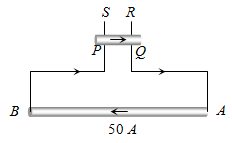
A long wire AB is placed on a table. Another wire PQ of mass 1.0 g and length 50 cm is set to slide on two rails PS and QR. A current of 50A is passed through the wires. At what distance above AB, will the wire PQ be in equilibrium
A cell of emf $6\, V$ and resistance $0.5\, ohm$ is short circuited. The current in the cell is ............... $amp$
The resistance of a galvanometer is $50\, ohm$ and the maximum current which can be passed through it is $0.002\, A$. What resistance must be connected to it in order to convert it into an ammeter of range $0 -0.5\, A$ ?....$ohm$
The tangent galvanometer, when connected in series with a standard resistance can be used as
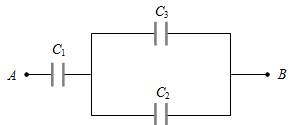
The combination of capacitors with $C_1=3\mu F, C_2=4\mu F$ and $C_3=2\mu F$ is charged by connecting AB to a battery. Consider the following statements
I. Energy stored in $C_1$ = Energy stored in $C_2$ + Energy stored in $C_3$
II. Charge on $C_1$ = Charge on $C_2$ + Charge on $C_3$
III. Potential drop across $C_1$​​​​​​​ = Potential drop across $C_2$ = Potential drop across $C_3$
Which of these is/are correct

 
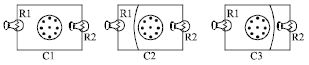
A solenoid is oriented end-on so that its opening is perpendicular to the circuit containing the two light bulbs as drawn in figure $C_1.$ For figure $C_2$ and $C_3,$ a shorting wire of negligible resistance is added as shown. Assume that the magnetic field from the solenoid, shown coming out of the plane of the page, decreases uniformly with time at the same rate for each circuit. Rank the circuits for the brightness of the bulb labeled $R_1$ from brightest to dimmest.
The dependence of drift velocity on applied electric field $E$ is: