Question
Which theory explained that electrons revolved in circular orbits?

Answer

  1. Bohr theory
Explanation:
Niels Bohr explained the line spectrum of the hydrogen atom with the assumption that electrons revolved around an atom in circular orbits and that the orbit closer to the nucleus represented the ground state and the farther orbits represented the higher levels of energy.

Need a full question paper?

Generate a complete, print-ready paper with questions like this in minutes — across 16+ boards, with answer keys.
Start Generating Free

Similar questions

Lateral displacement of the emergent ray of light increases with:
At the magnetic north pole of the earth, the value of horizontal component of earth's magnetic field and angle of dip are, respectively(a) Zero, maximum(b) Maximum, minimum(c) Maximum, maximum(d) Minimum, minimum
   
   
When the current changes from +2A to -2A in 0.05 second, an e.m.f. of 8V is induced in a coil. The coefficient of self-induction of the coil is:
The electric intensity due to an infinite cylinder of radius $R$ and  having charge $q$ per unit length at a distance $r(r > R)$ from its axis is
When a slab of dielectric material is introduced between the parallel plates of  a capacitor which remains connected to a battery, then charge on  plates relative to earlier charge(a) Is less(b) Is same(c) Is more(d) May be less or more depending on the nature of the material introduced


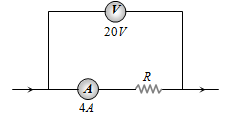
In the diagram shown, the reading of voltmeter is $20 V$ and that of ammeter is $4 A$. The value of $R$ should be $($Consider given ammeter and voltmeter are not ideal$)$
A conducting ring of radius 1 meter is placed in an uniform magnetic field B of 0.01Telsa oscillating with frequency 100Hz with its plane at right angles to B. What will be the induced electric field(a) π volt/m(b) 2 volt/m(c) 10 volt/m(d) 62 volt/m
       
The impedance of a series L - C - R circuit in an AC circuit is.
An object placed 10 cm in front of a lens has an image 20 cm behind the lens. What is the power of the lens (in dioptres)(a) 1.5(b) 3.0(c) – 15.0(d) + 15.0
       
The figure shows the intensity$-$wavelength relations of $X-$rays coming from two different Coolidge tubes. The solid curve represents the relation for the tube $A$ in which the potential difference between the target and the filament is $V_A$ and the atomic number of the target material is $Z_A.$ These quantities are $V_B$ and $Z_B$ for the other tube. Then$:$​​​​​​​