MCQ
Which theory is confirmed by the Davisson – Germer experiment?
- Ade – Broglie theory
- BNewton’s theory
- CEinstein’s theory
- DPlanck’s theory
Explanation:
Davisson and Germer experiment proves the concept of wave nature of matter particles. The Davisson–Germer experiment provides a critically important confirmation of the de-Broglie hypothesis, which said that particles, such as electrons, are of dual nature.
Generate a complete, print-ready paper with questions like this in minutes — across 16+ boards, with answer keys.
Two resistances are connected in two gaps of a metre bridge. The balance point is 20 cm from the zero end. A resistance of 15 ohms is connected in series with the smaller of the two. The null point shifts to 40 cm. The value of the smaller resistance in ohms is
|
(a) 3 |
(b) 6 |
(c) 9 |
(d) 12 |
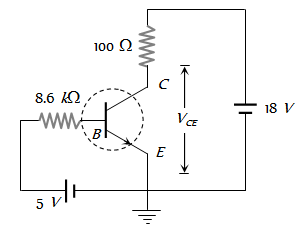
For the transistor circuit shown below, if b = 100, voltage drop between emitter and base is 0.7 V then value of VCE will be
|
(a) 10 V |
(b) 5 V |
(c) 13 V |
(d) 0 V |
Two lenses have focal lengths  and
and  and their dispersive powers are
  and
and  respectively. They will together form an achromatic combination if
|
(a) |
(b) |
|
(c) |
(d) |
The electric field in a region is radially outward with magnitude E =  . The charge contained in a sphere of radius
  centered at the origin is
|
(a) |
(b) |
(c) |
(d) |







