MCQ
Which theory of light is wave theory or particle theory?
  • A
    Dynamic physics
  • B
    Static physics
  • Quantum mechanics
  • D
    de $–$ Broglie hypothesis

Answer

Correct option: C.
Quantum mechanics

The essential theory of light was further evolved from electromagnetics into quantum mechanics. Einstein believed light is a particle, i.e. a photon and that the flow of these particles $($photons$)$ is a wave.

Need a full question paper?

Generate a complete, print-ready paper with questions like this in minutes — across 16+ boards, with answer keys.
Start Generating Free

Similar questions

If a radioactive element having half-life of $30\,min$ is undergoing beta decay, the fraction of radioactive element remains undecayed after $90\,min$. will be :
Einstein got Nobel prize on which of the following works:
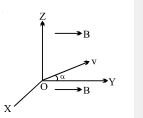
In a region of space, a uniform magnetic field $B$ exists in the $y-$direction.Aproton is fired from the origin, with its initial velocity $v$ making a small angle $\alpha$ with the $y-$ direction in the $yz$ plane. In the subsequent motion of the proton,
After five half lives what will be the fraction of initial substance
The current flow in a Zener diode is mainly due to
Radiations of monochromatic waves of wavelength $400\  nm$ are incident on the surface of metals $Zn$, $Fe$ and $Ni$ of work functions $3.4\  eV$, $4.8\  eV$ and $5.9\  eV$ respectively. (Take $hc = 1242\  eV\  nm$)

$(a)$ Maximum $KE$ associated with photoelectrons from the surface of any metal is $0.3\  eV$

$(b)$ No photoelectrons are emitted from the surface of $Ni$

$(c)$ If the frequency of the source of radiation is doubled then $KE$ of photoelectrons is also doubled

$(d)$ Photoelectrons will be emitted from the surfaces of all the three metals if the wavelength of the incident radiation is less than $200\  nm$

Correct statements are

In Young's double slit experiment, the distance between the slits is $1 \,mm$ and that between slit and screen is $1 $ meter and $10th $ fringe is $5 \,mm$ away from the central bright fringe, then wavelength of light used will be.....$\mathop A\limits^o $
In a semiconductor
When a dielectric material is introduced between the plates of a charges condenser, then electric field between the plates
In an experiment of photoelectric effect the number of photoelectrons has to be increased without changing their frequency. The suitable step to be taken about the incident radiation for this is: