MCQ
Which transition in the hydrogen atomic spectrum will have the same wavelength as the transition, $n = 4$ to $n = 2$ of $He^+$ spectrum?
- A$n = 4$ to $n = 3$
- B$n = 3$ to $n = 2$
- C$n = 4$ to $n = 2$
- ✓$n = 2$ to $n = 1$
${(2)^2}R\left[ {\frac{1}{{{2^2}}} - \frac{1}{{{4^2}}}} \right] = \frac{{3R}}{4}$
For hydrogen atoms, $\frac{1}{\lambda } = R\left[ {\frac{1}{{n_1^2}} - \frac{1}{{n_2^2}}} \right]$
$\frac{{3R}}{4} = R\left[ {\frac{1}{{n_1^2}} - \frac{1}{{n_2^2}}} \right]\,\frac{1}{{n_1^2}} - \frac{1}{{n_2^2}} = \frac{3}{4}$
$n_1 = 1$ and $n_2 = 2.$
Generate a complete, print-ready paper with questions like this in minutes — across 16+ boards, with answer keys.
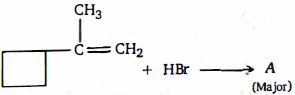
Assertion $A$ : Order of acidic nature of the following compounds is $A > B > C$.
$image$
Reason $R$ : Fluoro is a stronger electron withdrawing group than Chloro group.
In the light of the above statements, choose the correct answer from the options given below: