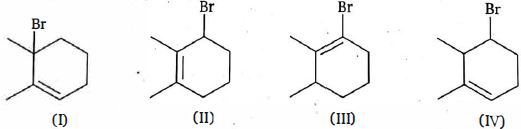
MCQ
Which two orbital are located along the axis and not between the axis ?
- A${d_{xy}},\,{d_{{z^2}}}$
- B${d_{xy}},\,{d_{{z}}}$
- C${d_{yz}},\,{p_x}$
- ✓${p_z}\,,\,\,{d_{{x^2} - {y^2}}}$
Generate a complete, print-ready paper with questions like this in minutes — across 16+ boards, with answer keys.
|
सूची-$I$ coordination compounds |
सूची-$II$ numbar of unpaired electrons |
| $A$ $\left[ Cr ( CN )_6\right]^{3-}$ | $I$ $0$ |
| $B$ $\left[ Fe \left( H _2 O \right)_6\right]^{2+}$ | $II$ $3$ |
| $C$ $\left[ Co \left( NH _3\right)_6\right]^{3+}$ | $III$ $2$ |
| $D$ $\left[ Ni \left( NH _3\right)_6\right]^{2+}$ | $IV$ $4$ |
Choose the correct answer from the options given below :-

What is structure of $(A)$ ?
The original compound showed these properties also :
$\mathop {{C_9}{H_{12}}{O_2}}\limits_{(A)} \,\xrightarrow{{Na}}\,{H_2}$ liberated
$\mathop {{C_9}{H_{12}}{O_2}}\limits_{(A)} \,\xrightarrow{{Br}}$ no rapid reaction
$\mathop {{C_9}{H_{12}}{O_2}}\limits_{(A)} \,\xrightarrow[{cool}]{{Cr{O_3}\,/\,{H^ + }}}{C_9}{H_8}{O_3}$