Question
Which value(s) of $\lambda,$ do the pair of linear equations $\lambda\text{x}+\text{y}=\lambda^2$ and $\text{x}+\lambda\text{y}=1$ have:
No solution?

Answer

The given pair of linear equations is
$\lambda\text{x}+\text{y}=\lambda^2$ and $\text{x}+\lambda\text{y}=1$
Here,
$\text{a}_1=\lambda,\text{b}_1=1,\text{c}_1=-\lambda^2$
$\text{a}_2=1,\text{b}_2=\lambda,\text{c}_2=-1$
For no solution,
$\frac{\text{a}_1}{\text{a}_1}=\frac{\text{b}_1}{\text{b}_2}\neq\frac{\text{c}_1}{\text{c}_2}$
$\Rightarrow\frac{\lambda}{1}=\frac{1}{\lambda}\neq\frac{-\lambda^2}{-1}$
$\Rightarrow\lambda^2-1=0$
$\Rightarrow(\lambda-1)(\lambda+1)=0$
$\Rightarrow\lambda=1,-1$
Here, we take only $\lambda=-1$ because at $\lambda=1$ the system of linear equations has infinitely many solutions.

Need a full question paper?

Generate a complete, print-ready paper with questions like this in minutes — across 16+ boards, with answer keys.
Start Generating Free

Similar questions

The $n^{th}$ term of an A.P is given by $(-4n + 15),$ Find the sum of first $20$ terms of this A.P.
Prove that $\sqrt 5 $ is irrational.
Solve for x.
$\frac{1}{\text{x}}+\frac{2}{2\text{x}-3}=\frac{1}{\text{x}-2},$ $\text{x}\neq0,\frac{3}{2},2$
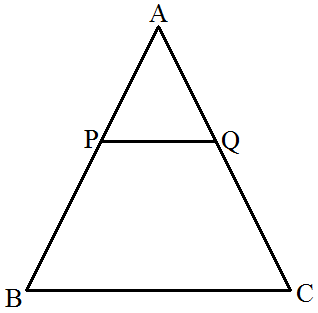
In figure, $PQ || BC$ and $AP : PB = 1 : 2.$
Find: $\frac{\text{area}(\triangle\text{APQ})}{\text{area}(\triangle\text{ABC})}$
$ABC$ is a triangle in which $\angle\text{A}=90^\circ,\ \text{AN}\perp\text{BC} BC = 12\ cm$ and $AC = 5\ cm.$ Find the ratio of the area of $\triangle\text{ANC}$ and $\triangle\text{ABC}.$
Find the indicated terms in the following sequences whose $n^{th}$ terms are:
$\text{a}_\text{n}=\frac{3\text{n}-2}{4\text{n}+5};\text{a}_7\text{ and }\text{a}_8$
Three vertices of a parallelogram are $(a + b, a - b), (2a + b, 2a - b), (a - b, a + b).$ Find the fourth vertex.
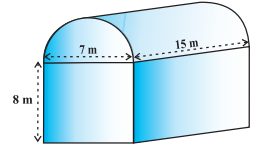
Shanta runs an industry in a shed which is in the shape of a cuboid surmounted by a half cylinder. If the base of the shed is of dimension $7\ m \times 15\ m$ and the height of the cuboidal portion is $8\ m,$ find the volume of air that the shed can hold. Further, suppose the machinery in the shed occupies a total space of $300\ m^3,$ and there are $20$ workers, each of whom occupy about $0.08\ m^3$ space on an average. Then, how much air is in the shed$? ($Take $\pi = \frac {22}7)$
Solve the following quadratic equation:
$ 4 x^2+4 b x-\left(a^2-b^2\right)=0 $
Sushant has a vessel, of the form of an inverted cone, open at the top, of height $11\ cm$ and radius of top as $2.5\ cm$ and is full of water. Metallic spherical balls each of diameter $0.5\ cm$ are put in the vessel due to which $\Big(\frac{2}{5}\Big)^\text{th}$ of the water in the vessel flows out. Find how many balls were put in the vessel. Sushant made the arrangement so that the water that flows out irrigates the flower beds. What value has been shown by Sushant$?$