Question
Which waves are electromagnetic waves?Which factors are responsible for their production?

Answer

It is a three-dimensional wave which is produced by oscillating electric circuit. Their electric and magnetic fields are mutually perpendicular. These waves do not require any material medium for their propagation.
Reasons for their production : (i) Mechanical energy of the charge vibrating in oscillating electric field gets converted into electromagnetic waves.
(ii) Due to oscillation of charge, kinetic energy of the charge gets converted into electromagnetic waves.

Need a full question paper?

Generate a complete, print-ready paper with questions like this in minutes — across 16+ boards, with answer keys.
Start Generating Free

Similar questions

Two identically charged particles are fastened to the two ends of a spring of spring constant $100Nm^{-1}$ and natural length $10\ cm.$ The system rests on a smooth horizontal table. If the charge on each particle is $2.0 \times 10^{-8}C,$ find the extension in the length of the spring. Assume that the extension is small as compared to the natural length. Justify this assumption after you solve the problem.
A 100W light bulb is placed at the centre of a spherical chamber of radius 20cm. Assume that 60% of the energy supplied to the bulb is converted into light and that the surface of the chamber is perfectly absorbing. Find the pressure exerted by the light on the surface of the chamber.
Name the following constituent radiations of electromagnetic spectrum which
  1. produce intense heating effect.
  2. is absorbed by the ozone layer in the atmosphere.
  3. is used for studying crystal structure.
Write one more application forr each of these radiations.
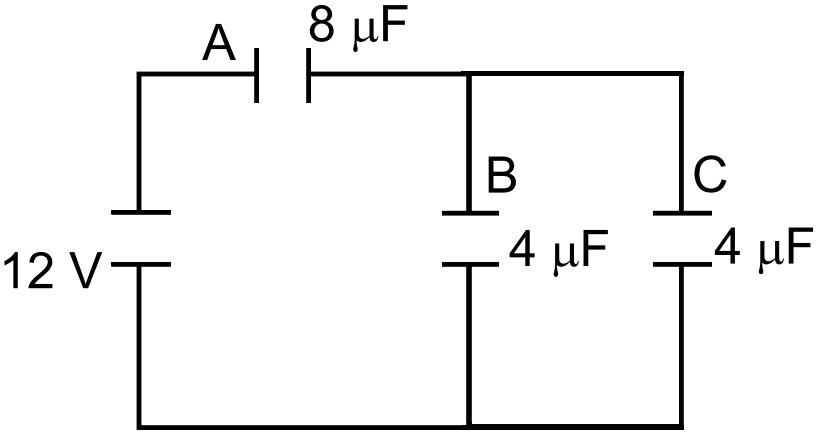
Find the charge appearing on each of the three capacitors shown in figure.
On the basis of the charging of capacitor, clarify that there is something missing in the Ampere circuital law.
  1. Draw a ray diagram for the formation of image by a compound microscope.
  2. You are given the following three lenses. Which two lenses will you use as an eyepiece and as an objective to construct a compound microscope?
Lenses Power $(D)$ Aperture $(cm)$
$L_1$ $3$ $8$
$L_2$ $6$ $1$
$L_3$ $10$ $1$
  1. Define resolving power of a microscope and write one factor on which it depends.
Monochromatic light of wavelength 589 nm is incident from air on a water surface. What are the wavelength, frequency and speed of (a) reflected, and (b) refracted light? Refractive index of water is 1.33.
Consider a radioactive nucleus $A$ which decays to a stable nucleus $C$ through the following sequence$: A \rightarrow B \rightarrow C$
Here $B$ is an intermediate nuclei which is also radioactive. Considering that there are $N_0$ atoms of $A$ initially, plot the graph showing the variation of number of atoms of $A$ and $B$ versus time.
  1. Name the phenomenon on which the working of an optical fibre is based.
  2. What are the necessary conditions for this phenomenon to occur?
  3. Draw a labelled diagram of an optical fibre and show how light propagates through the optical fibre using this phenomenon.
The ground state energy of hydrogen atom is is - 13.6 eV. What are the kinetic and potential energies of the electron in this state?