MCQ
Which will give $Fe^{3+}$ ions in solution ?
- A$[Fe(CN)_6]^{3-}$
- ✓$Fe_2(SO_4)_3$
- C$[Fe(CN)_6]^{4-}$
- D$(NH_4)_2SO_4. FeSO_4.6H_2O$
Generate a complete, print-ready paper with questions like this in minutes — across 16+ boards, with answer keys.
Benzene $(C_6H_6)$ $+\,C{{H}_{3}}-CH=C{{H}_{2}}\,\xrightarrow{{{H}^{\oplus }}}A\xrightarrow{{{O}_{2}}}B$ $\xrightarrow{{{H}^{\oplus }}\,/\,\Delta }C+$$\begin{matrix}
O \\
|| \\
C{{H}_{3}}-C-C{{H}_{3}} \\
\end{matrix}$
The structure of intermediate compound $'B'$ will be
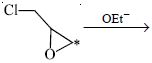
$Image$
In this reaction, $\mathrm{RCONHBr}$ is formed from which this reaction has derived its name. Electron donating group at phenyl activates the reaction. Hofmann degradation reaction is an intramolecular reaction.
$1.$ How can the conversion of $(i)$ to $(ii)$ be brought about?
$(A)$ $\mathrm{KBr}$ $(B)$ $\mathrm{KBr}+\mathrm{CH}_3 \mathrm{ONa}$ $(C)$ $\mathrm{KBr}+\mathrm{KOH}$ $(D)$ $\mathrm{Br}_2+\mathrm{KOH}$
$2.$ Which is the rate determining step in Hofmann bromamide degradation?
$(A)$ Formation of $(i)$ $(B)$ Formation of $(ii)$ $(C)$ Formation of $(iii)$ $(D)$ Formation of $(iv)$
$3.$ What are the constituent amines formed when the mixture of $(i)$ and $(ii)$ undergoes Hofmann bromamide degradation?
$Image$
give the answer question $1$, $2$, and $3.$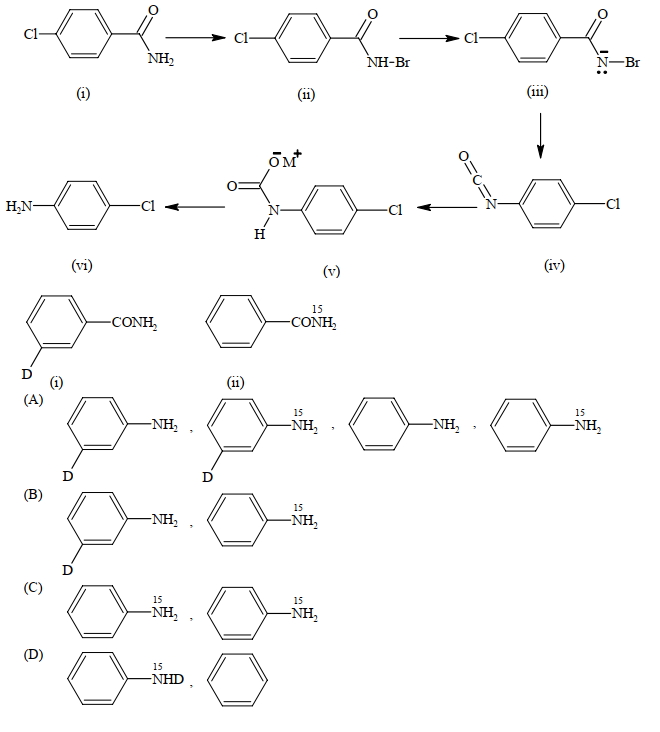
Product will be