MCQ
Which will make basic buffer?
  • A
     $50 \mathrm{mL}$ of $0.1 \mathrm{M} \mathrm{NaOH}+25 \mathrm{mL}$ of $0.1 \mathrm{M} \mathrm{CH}_{3} \mathrm{COOH}$
  • B
    $100 \mathrm{mL}$ of $0.1 \mathrm{M} \mathrm{CH}_{3} \mathrm{COOH}+100 \mathrm{mL}$ of $0.1 \mathrm{M} \mathrm{NaOH}$
  • $100 \mathrm{mL}$ of $0.1 \mathrm{M} \mathrm{HCl}+200 \mathrm{mL}$ of $0.1 \mathrm{M} \mathrm{NH}_{4} \mathrm{OH}$
  • D
     $100 \mathrm{mL}$ of $0.1 \mathrm{M} \mathrm{HCl}+100 \mathrm{mL}$ of $0.1 \mathrm{M} \mathrm{NaOH}$

Answer

Correct option: C.
$100 \mathrm{mL}$ of $0.1 \mathrm{M} \mathrm{HCl}+200 \mathrm{mL}$ of $0.1 \mathrm{M} \mathrm{NH}_{4} \mathrm{OH}$
c
Basic buffer is mixture of weak base and salt of weak base with strong acid

milli mole of $\mathrm{HCl}=100 \times 0.1=10$ milli mole

milli mole of $\mathrm{NH}_{4} \mathrm{OH}=200 \times 0.1=20 \mathrm{mill}$ imole

$\mathrm{HCl}+\mathrm{NH}_{4} \mathrm{OH} \rightarrow \mathrm{NH}_{4} \mathrm{Cl}+\mathrm{H}_{2} \mathrm{O}^{-}$

$10 \quad \quad \quad 20\quad \quad \quad \quad -\quad \quad -$

$-\quad \quad \quad 10\quad \quad \quad \quad  10\quad \quad \quad -$

Need a full question paper?

Generate a complete, print-ready paper with questions like this in minutes — across 16+ boards, with answer keys.

Start Generating Free

Similar questions

Match the catalysts to the correct processes : 

Catalyst  Process 
$(A)$  $TiCl_4$ $(i)$  Wacker process
$(B)$  $PdCl_2$ $(ii)$  Ziegler - Natta polymerization
$(C)$  $CuCl_2$ $(iii)$  Contact process
$(D)$  $V_2O_5$ $(iv)$  Deacon's process


Thermal decomposition of gaseous $\mathrm{X}_2$ to gaseous $\mathrm{X}$ at $298 \mathrm{~K}$ takes place according to the following equation :

$\mathrm{X}_2(g) \rightleftharpoons 2 \mathrm{X}(g)$

The standard reaction Gibbs energy, $\Delta_r G^{\circ}$, of this reaction is positive. At the stiur of the reaction, there is one mole of $X_2$ and no $X$. As the reaction proceeds, the number of roles of $X$ formed is given by $\beta$. Thus, $\beta_{\text {equitibrium }}$ is the number of moles of $\mathrm{X}$ formed at equilibrium. The reaction is carried out at a constant total pressure of 2 bar. Consider the gases to behave ideally. (Given : $R=0.083 \mathrm{~L} \mathrm{bar}^{-1} \mathrm{~mol}^{-1}$ )

($1$) The equilibrium constant $K_P$ for this reaction at $298 \mathrm{~K}$, in terms of $\beta_{\text {equilibs, um }}$, is

($A$) $\frac{8 \beta_{\text {equilibrium }}^2}{2-\beta_{\text {equilibrium }}}$    ($B$) $\frac{8 \beta_{\text {equititrium }}^2}{4-\beta_{\text {equilibrium }}^2}$     ($C$) $\frac{4 \beta_{\text {equilibrium }}^2}{2-\beta_{\text {equilibrium }}}$   ($D$) $\frac{4 \ell_{\text {equitibrium }}^2}{4-\beta_{\text {equilibrium }}^2}$

($2$) The $INCORRECT$ statement among the following, for this reaction, is

($A$) Decrease in the total pressure will result in formation of more moles of gaseous $\mathrm{X}$

($B$) At the start of the reaction, dissociation of gaseous $\mathrm{X}_2$ takes place spontaneously

($C$) $\beta_{\text {equilibrium }}=0.7$

($D$) $\quad K_c<1$

Given the answer question ($1$) and ($2$) 
Among the following the coloured compound is
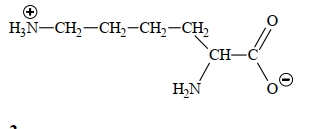
The total number of basic groups in the following form of lysine is 
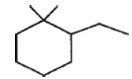
The correct nomenclature for the following compound is:
The nucleus of tritium contains
Which of the following compounds will exhibit  $cis-$trans (geometrical) isomerism ?
Nitrosobenzene can be isolated from nitrobenzene under
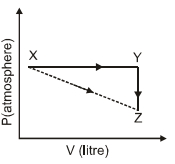
For an ideal gas, consider only $P - V$ work in going from an initial state $X$ to the final stat $Z$. The final state $Z$ can be reached by either of the two paths shown in the figure. Which of the following choice$(s)$ is (are) correct? [take $\Delta S$ as change in entropy and w as work done].

$(A)$ $\Delta S _{ x \rightarrow z}=\Delta S _{ x \rightarrow y}+\Delta S _{ y \rightarrow z}$

$(B)$ $w_{x \rightarrow z}=w_{x \rightarrow y}+w_{y \rightarrow z}$

$(C)$ $w_{x \rightarrow z \rightarrow z}=w_{x \rightarrow y}$

$(D)$ $\Delta S _{x \rightarrow y \rightarrow z}=\Delta S _{x \rightarrow y}$

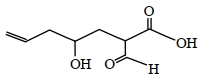
The $IUPAC$ name of the following compound is: