MCQ
Which will make basic buffer?
  • A
     $50 \mathrm{mL}$ of $0.1 \mathrm{M} \mathrm{NaOH}+25 \mathrm{mL}$ of $0.1 \mathrm{M} \mathrm{CH}_{3} \mathrm{COOH}$
  • B
    $100 \mathrm{mL}$ of $0.1 \mathrm{M} \mathrm{CH}_{3} \mathrm{COOH}+100 \mathrm{mL}$ of $0.1 \mathrm{M} \mathrm{NaOH}$
  • $100 \mathrm{mL}$ of $0.1 \mathrm{M} \mathrm{HCl}+200 \mathrm{mL}$ of $0.1 \mathrm{M} \mathrm{NH}_{4} \mathrm{OH}$
  • D
     $100 \mathrm{mL}$ of $0.1 \mathrm{M} \mathrm{HCl}+100 \mathrm{mL}$ of $0.1 \mathrm{M} \mathrm{NaOH}$
Answer

Correct option: C.
$100 \mathrm{mL}$ of $0.1 \mathrm{M} \mathrm{HCl}+200 \mathrm{mL}$ of $0.1 \mathrm{M} \mathrm{NH}_{4} \mathrm{OH}$
c
Basic buffer is mixture of weak base and salt of weak base with strong acid

milli mole of $\mathrm{HCl}=100 \times 0.1=10$ milli mole

milli mole of $\mathrm{NH}_{4} \mathrm{OH}=200 \times 0.1=20 \mathrm{mill}$ imole

$\mathrm{HCl}+\mathrm{NH}_{4} \mathrm{OH} \rightarrow \mathrm{NH}_{4} \mathrm{Cl}+\mathrm{H}_{2} \mathrm{O}^{-}$

$10 \quad \quad \quad 20\quad \quad \quad \quad -\quad \quad -$

$-\quad \quad \quad 10\quad \quad \quad \quad  10\quad \quad \quad -$

Need a full question paper?

Generate a complete, print-ready paper with questions like this in minutes — across 16+ boards, with answer keys.

Start Generating Free

Similar questions

Which of the following is low boiling azeotropic mixture
Which one is not synthesized by Grignard reagent
Resonance is due to
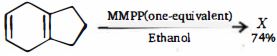
$MMPP \to$ Magnesium mono peroxy phthalate. Product $(X)$ is
Given below are the statements about diborane.

$(a)$ Diborane is prepared by the oxidation of $\mathrm{NaBH}_{4}$ with $\mathrm{I}_{2}$.

$(b)$ Each boron atom is in sp $^{2}$ hybridized state.

$(c)$ Diborane has one bridged $3$ centre$-2-$electron bond.

$(d)$ Diborane is a planar molecule.

The option with correct statement(s) is :

Which of the given statements is $INCORRECT$ about glycogen?
The following reaction is suppose to take place through ${{S}_{{{N}^{1}}}}$ mechanism

$\mathop {\begin{array}{*{20}{c}}
{{\mkern 1mu} {\mkern 1mu} Ph}\\
|\\
{C{H_3} - C - OH}\\
|\\
{{\mkern 1mu} {\mkern 1mu} {\mkern 1mu} {\mkern 1mu} {\mkern 1mu} {\mkern 1mu} {\mkern 1mu} {\mkern 1mu} {\mkern 1mu} {\mkern 1mu} {\mkern 1mu} {\mkern 1mu} {\mkern 1mu} {\mkern 1mu} {\mkern 1mu} {\mkern 1mu} {\mkern 1mu} {\mkern 1mu} {\mkern 1mu} {\mkern 1mu} {\mkern 1mu} {\mkern 1mu} {\mkern 1mu} \,\,\,\,\,\,\,\,\,\,\,\,\,\,\,\,\,\,\,\,\,\,C{H_2} - C{H_3}{\mkern 1mu} {\mkern 1mu} }
\end{array}}\limits_{{\rm{'D'}}} $ $\xrightarrow{{HI}}$ products

If the configuration of substrate is $D$, then configuration of products will be

The mode of hybridisation of carbon in $C{O_2}$ is
Consider two reactions

$(I)\,\,Zn\,+\,Conc. HNO_3\,(hot) \to  Zn(NO_3)_2\,+\,X\,+\,H_2O$

$(II)\,\,Zn\,+\,dil. HNO_3\,(Cold) \to Zn(NO_3)_2\,+\,Y\,+\,H_2O$

Compound $X$ and $Y$ are respectively

When $2-$ butyne is treated with $H_2/$ Lindlar's catalyst, compound $X$ is produced as the major product and when treated with $Na/liq.$ $NH_3$ it produces $Y$ as the major product. Which of the following statements is correct?