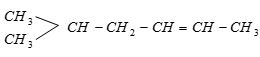
MCQ
Which will undergo reaction with ammoniacal $AgN{O_3}$
  • A

  • $C{H_3} - CH = CH - C \equiv CH$
  • C
    $C{H_3} - C{H_2} - CH = CH - C{H_2} - C{H_3}$
  • D
    $C{H_2} = CH - C{H_2} - C{H_3}$

Answer

Correct option: B.
$C{H_3} - CH = CH - C \equiv CH$
b
(b) $C{H_3} - CH = CH - C \equiv C - H$.   Acidic hydrogen

($H$ atom attached to triple bond) is present therefore it gives reaction with ammoniacal $AgN{O_3}$.

Need a full question paper?

Generate a complete, print-ready paper with questions like this in minutes — across 16+ boards, with answer keys.

Start Generating Free

Similar questions

Moissan boron is
$p$-Amino- $N, N$-dimethylaniline is added to a strongly acidic solution of ${X}$. The resulting solution is treated with a few drops of aqueous solution of ${Y}$ to yield blue coloration due to the formation of methylene blue. Treatment of the aqueous solution of ${Y}$ with the reagent potassium hexacyanoferrate$(II)$ leads to the formation of an intense blue precipitate. The precipitate dissolves on excess addition of the reagent. Similarly, treatment of the solution of ${Y}$ with the solution of potassium hexacyanoferrate$(III)$ leads to a brown coloration due to the formation of ${Z}$.

$1.$ The compound ${X}$ is

$(A)$ $\mathrm{NaNO}_3$ $(B)$ $\mathrm{NaCl}$ $(C)$ $\mathrm{Na}_2 \mathrm{SO}_4$ $(D)$ $\mathrm{Na}_2 \mathrm{~S}$

$2.$ The compound ${Y}$ is

$(A)$ $\mathrm{MgCl}_2$ $(B)$ $\mathrm{FeCl}_2$ $(C)$ $\mathrm{FeCl}_3$ $(D)$ $\mathrm{ZnCl}_2$

$3.$ The compound ${Z}$ is

$(A)$ $\left.\mathrm{Mg}_2 \mid \mathrm{Fe}(\mathrm{CN})_6\right]$ $(B)$ $\operatorname{Fe}\left[\mathrm{Fe}(\mathrm{CN})_6\right]$

$(C)$ $\mathrm{Fe}_4\left[\mathrm{Fe}(\mathrm{CN})_6\right]_3$ $(D)$ $\mathrm{K}_2 \mathrm{Zn}_3\left[\mathrm{Fe}(\mathrm{CN})_6\right]_2$

Give the answer question $1,2$ and $3.$

Will $F{e_{(s)}}$be oxidised to $F{e^{2 + }}$ by the reaction with $1\,M $ $HCl$ $({E^o}$ for $Fe/F{e^{2 + }}$ $= + 0.44\,V)$
Cellulose is a polymer of
The $IUPAC$ name of is

$C{H_3} - \mathop {\mathop {C = }\limits_{|\,\,\,\,} }\limits_{C{l_{}}\,} \mathop {\mathop {C\, - }\limits_{|\,\,\,\,\,\,} }\limits_{C{H_3}\,} \mathop {\mathop {CH - \,}\limits_{|\,\,\,\,\,\,\,\,\,} }\limits_{{C_2}{H_5}\,} C{H_2} - C \equiv CH$

In which of the compound does hydrogen have an oxidation state of $- 1$ ?
What is the mole ratio of benzene $({P_B}^0 = 150\ torr)$ and toluene $({P_T}^0 = 50\ torr)$ in vapour phase if the given solution has a vapour pressure of $120\ torr$ ?
${H_3}P{O_2}\xrightarrow{\Delta }(X) + P{H_3}$ is
One mole of an ideal gas is allowed to expand reversibly and adiabatically from a  temperature of $27\,^oC$. If the work done during the process is $3\, kJ$, then final  temperature of  the gas is $(C_v = 20\, J/K)$ .....$K$
In the presence of a small amount of phosphorous, aliphatic carboxylic acids react with chlorine or bromine to yield a compound in which $\alpha -$ hydrogen has been replaced by halogen. This reaction is known as