MCQ
Which would exhibit co-ordination isomerism
  • $\left[ {Cr{{(N{H_3})}_6}} \right]\,\left[ {Co{{(CN)}_6}} \right]$
  • B
    $\left[ {Co{{(en)}_2}C{l_2}} \right]$
  • C
    $\left[ {Cr{{\left( {N{H_3}} \right)}_6}} \right]C{l_3}$
  • D
    ${\left[ {Cr{{(en)}_2}C{l_2}} \right]^ + }$

Answer

Correct option: A.
$\left[ {Cr{{(N{H_3})}_6}} \right]\,\left[ {Co{{(CN)}_6}} \right]$
a
Coordination isomerism is a form of structural isomerism in which the composition of the complex ion varies. In a coordination isomer the total ratio of ligand to metal remains the same, but the ligands attached to a specific metal ion change. Examples of a complete series of coordination isomers require at least two.

Need a full question paper?

Generate a complete, print-ready paper with questions like this in minutes — across 16+ boards, with answer keys.

Start Generating Free

Similar questions

The volume of water which must be added to $40\,cc$ of $0.25\,M$ oxalic acid solution to make it exactly decimolar $(0.1\,M)$ is ....... $cc$.
$\begin{array}{*{20}{c}}
  {C{H_3} - C - H} \\ 
  {\,\,\,\,\,\,\,\,\,||\,\,\,\,\,} \\ 
  {\,\,\,\,\,\,\,\,O\,\,\,\,} 
\end{array}$ $\xrightarrow{{NaOH + C{l_2}}}A + HCOONa$ Product $A$ is can be used as
Haemoglobin is 
Find out the reaction in which obtained product give positive isocyanide test
Presence of which reagent will affect the reversibility of the following reaction, and change it to a irreversible reaction:

$\mathrm{CH}_{4}+\mathrm{I}_{2} \underset{\text { Reversible }}{\stackrel{\mathrm{hv}}{\longrightarrow}} \mathrm{CH}_{3}-\mathrm{I}+\mathrm{HI}$ 

Product of the reaction will be
$\begin{matrix}
   C{{H}_{3}}\,\,\,\,\,\,\,\,\,\,\,\,\,\,\,\,\,\,\,\,\,\,\,\,\,  \\
   |\,\,\,\,\,\,\,\,\,\,\,\,\,\,\,\,\,\,\,\,\,\,\,\,\,\,\,\,\,\,\,\,  \\
   Cl-C{{H}_{2}}-C-C{{H}_{2}}-C{{H}_{2}}-Cl+{{I}^{-}}  \\
   |\,\,\,\,\,\,\,\,\,\,\,\,\,\,\,\,\,\,\,\,\,\,\,\,\,\,\,\,\,\,\,\,\,  \\
   \,C{{H}_{3}}\,\,\,\,\,\,\,\,\,\,\,\,\,\,\,\,\,\,\,\,\,\,\,\,\,\,\,  \\
\end{matrix}\xrightarrow[DMF]{}$  product; Major product of this reaction is
How much chlorine will be liberated on passing one ampere current for $30 $ minutes through $ NaCl $ solution
Mechanism of a hypothetical reaction

$X_2 + Y_2 \rightarrow 2XY,$ is given below :

$(i)\,\, X_2 \rightarrow X + X\, (fast)$

$(ii)\,\,X + Y_2 \rightleftharpoons XY + Y\, (slow)$

$(iii)\,\,X + Y \rightarrow XY\, (fast)$

The overall order of the reaction will be

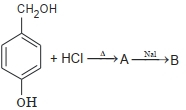
In the above reaction product $B$ is: