MCQ
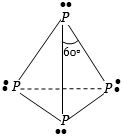
White phosphorus $\left( {{P_4}} \right)$ has
  • A
    Six $P - P$ single bonds
  • B
    Four lone pairs of electrons
  • C
    $PPP$ angle of ${60^o}$
  • Both (a) and (c)

Answer

Correct option: D.
Both (a) and (c)
d
(d) $P_4$ molecule

Bond angle $ = 60^o$

Six $P-P =$ Single bonds

Lone pairs $=4$
Need a full question paper?

Generate a complete, print-ready paper with questions like this in minutes — across 16+ boards, with answer keys.

Start Generating Free

Similar questions

Which of the following compound gives the smell of mustard oil:
Which of the following statements are correct?
$A.$ Among halogens, radius ratio between iodine and fluorine is maximum.
$B.$ Leaving $F—F$ bond, all halogens have weaker $X—X$ bond than $X—X\ '$ bond in interhalogens.
$C.$ Among interhalogen compounds maximum number of atoms are present in iodine fluoride.
$D.$ Interhalogen compounds are more reactive than halogen compounds.
Strongest nucleophile in polar protic solvent is
Molar conductivity $\left(\Lambda_m\right)$ of aqueous solution of sodium stearate, which behaves as a strong electrolyte, is recorded at varying concentration($c$) of sodium stearate. Which one of the following plots provides the correct representation of micelle formation in the solution?

(Critical micelle concentration ($CMC$) is marked with an arrow in the figures.)

Which of the following is a bidentate ligand?
In the given reaction :

 $\begin{array}{*{20}{c}}
  {{C_6}{H_5} - C - H} \\ 
  {\,\,\,\,\,\,\,\,\,\,||} \\ 
  {\,\,\,\,\,\,\,\,\,\,\,\,O} 
\end{array}\xrightarrow{{N{H_2}OH/{H^ \oplus }}}[X]$

$[X] $ will be :

$10\,gm$ mixture of two gases $A_2$ (mol.wt. $= 20$) and $B_2$ (mol. wt. $= 30$), which decompose by first order kinetics, was taken in a vessel. The half life of decomposition of $A_2$ and $B_2$ are $2$ and $3$ hours respectively. After $6$ hours weight of mixture of $A_2$ and $B_2$ is found to be $2\,gm$. Find the weight of $A_2$ in the initial mixture .......... $gm$
Which of the following structures represents thymine ?
$Ti^{3+}(aq)$ is violet while $Ti^{4+}(aq$) is colourless because$−$
Which of the following compound show optical isomerism?