Question
Who gave the Quantum model of hydrogen atom?

Answer

  1. Niels Bohr
Explanation:
Niels Bohr introduced the atomic Hydrogen model in 1913.
Neils Bohr developed the Bohr model of the atom, in which he proposed that energy levels of electrons are discrete and that the electrons revolve in stable orbits around the atomic nucleus but can jump from one energy level (or orbit) to another.

Need a full question paper?

Generate a complete, print-ready paper with questions like this in minutes — across 16+ boards, with answer keys.
Start Generating Free

Similar questions

An electromagnetic wave travelling along z-axis is given as: $\text{E}=\text{E}_0\cos(\text{kz}-\omega\text{t})$. Choose the correct options from the following;
The amplitude of the sinusoidally oscillating electric field of a plane wave is $60\ v/m.$ Then the amplitude of the magnetic field is$:$
In a triclinic crystal system(a) a ≠ b ≠ c, α ≠ β ≠ γ(b) a = b = c, α ≠ β  ≠ γ(c) a ≠ b ≠ c, α ≠  β =  γ(d) a  = b ≠ c, α  = β = γ
   
   
For a nuclear fusion process, suitable nuclei are:
Laser beams are used to measure long distances because (a) They are monochromatic(b) They are highly polarised(c) They are coherent(d) They have high degree of parallelism
   
   
A NPN transistor conducts when(a) Both collector and emitter are positive with respect to the base (b) Collector is positive and emitter is negative with respect to the base(c) Collector is positive and emitter is at same potential as the base(d) Both collector and emitter are negative with respect to the base


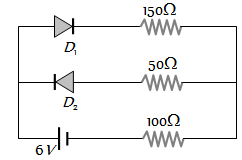
The circuit shown in following figure contains two diode $D_1$ and $D_2$ each with a forward resistance of $50$ ohms and with infinite backward resistance. If the battery voltage is $6 V,$ the current through the $100$ ohm resistance $($in amperes$)$ is
The wave theory of light, in its original form, was first postulated by.
In a photon-particle collision, the quantity that does not remain conserved is:
Two sources give interference pattern which is observed on a screen, D distance apart from the sources. The fringe width is 2w. If the distance D is now doubled, the fringe width will(a) Become w/2(b) Remain the same(c) Become w(d) Become 4w