MCQ
Who proposed the wave theory of light?
  • A
    G.P. Thomson.
  • Huygens.
  • C
    M. Planck.
  • D
    Maxwell.

Answer

Correct option: B.
Huygens.

Need a full question paper?

Generate a complete, print-ready paper with questions like this in minutes — across 16+ boards, with answer keys.
Start Generating Free

Similar questions

Supposing Newton's law of gravitation for gravitation forces $F_1$ and $F_2$ between two masses $m_1$ and $m_2$ at positions $r_1$ and $r_2$ read $F_1=-F_2=-\frac{r^{12}}{r_{12}^3} G_0^2\left(\frac{m_1 m_2}{M_0^2}\right)^n$ where $M_0$ is a constant of dimension of mass, $r_{12}=r_1-r_2$ and $n$ is a number. In such a case,
  1. The acceleration due to gravity on earth will be different for different objects.
  2. None of the three laws of Kepler will be valid.
  3. Only the third law will become invalid.
  4. For $n$ negative, an object lighter than water will sink in water.
$Assertion :$ In isothermal process whole of the heat supplied to the body is converted into internal energy.
$Reason :$ According to the first law of thermodynamics :  $\Delta Q = \Delta U + p\Delta V$
Coefficient of linear expansion of a vessel completely filled with $Hg$ is $1 \times 10^{-5} /{ }^{\circ} C$. If there is no overflow of $Hg$ on heating the vessel, then coefficient of cubical expansion of $Hg$ is ......
A standing wave is generated on a string. Which of the following statement$(s)$ is/are correct for the standing waves?
A person travelling on a straight line moves with a uniform velocity $v_1$ for a distance $x$ and with a uniform velocity $v-2$ for the next equal distance. The average velocity $v$ is given by:
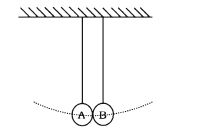
Two pendulums with identical bobs and lengths are suspended from a common support such that in rest position the two bobs are in contact (figure). After being displaced by $5^o $ the bob $A$ is released from rest, at $t = 0$ subsequently it collides elastically head-on with the other bob.The graph showing variation in energy of pendulum $A$ with time, for $0 \leqslant t \leqslant T$ (where $T$ is the period of either pendulum).
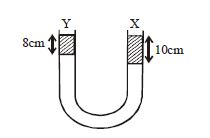
A liquid $X$ of density $3.36\  g/cm^3$ is poured in a $U-$ tube, which contains $Hg$. Another liquid $Y$ is poured in left arm with height $8\  cm$, upper levels of $X$ and $Y$ are same. What is density of $Y$ .......... $g/cc$
The path Difference between the two waves ${y_1} = {a_1}\,\sin \,\left( {\omega t - \frac{{2\pi x}}{\lambda }} \right)$ and ${y_2} = {a_2}\,\cos \,\left( {\omega t - \frac{{2\pi x}}{\lambda } + \phi } \right)$ is
Kinetic theory of gases provide a base for
The relation $3t = \sqrt {3x} + 6$ describes the displacement of a particle in one direction where $x$ is in metres and $t$ in sec. The displacement, when velocity is zero, is.........$metres$