MCQ
Why are alkali metals most suited as photo$-$sensitive metals?
  • A
    High frequency
  • B
    Zero rest mass
  • C
    High work function
  • Low work function

Answer

Correct option: D.
Low work function

Alkali metals have low work functions. Even visible radiation can eject out electrons from them. So alkali metals are the most suitable photo$-$sensitive metals.

Need a full question paper?

Generate a complete, print-ready paper with questions like this in minutes — across 16+ boards, with answer keys.
Start Generating Free

Similar questions

Three charges $2 q,-q$ and $-q$ are located at the vertices of an equilateral triangle. At the center of the triangle
When light travels from air to water and from water to glass, again from glass to $C{O_2}$ gas and finally through air. The relation between their refractive indices will be given by
A transistor connected at common emitter mode contains load resistance of $5\,k \Omega$. If the input peak voltage is $5\,mV$ and the current gain is $50$, find the voltage gain.
A square of side ‘$a$’ has charge $Q$ at its centre and charge ‘$q$’ at one of the corners. The work required to be done in moving the charge ‘$q$’ from the corner to the diagonally opposite corner is
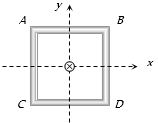
A square coil $ABCD$ lying in $x-y$ plane with it’s centre at origin. A long straight wire passing through origin carries a current $i = 2t$ in negative $z$-direction. The induced current in the coil is
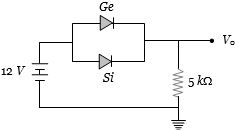
Ge and Si diodes conduct at $0.3 \,V$ and $0.7\, V$ respectively. In the following figure if Ge diode connection are reversed, the valve of $V0$ changes by.....$V$
If a proton is projected in a direction perpendicular to a uniform magnetic field with velocity $v$ and an electron is projected along the lines of force, what will happen to proton and electron
The dimension of the magnetic field intensity B is
Which of the following graphs shows the variation of electric field E due to a hollow spherical conductor of radius R as a function of distance from the centre of the sphere
You are asked to design a shaving mirror assuming that a person keeps it $10\,cm$ from his face and views the magnified image of the face at the closest comfortable distance of $25\,cm.$ The radius of curvature of the mirror would then be.....$cm$