Question
Why are mountain roads generally made winding upwards rather than going straight up?

Answer

On an inclined plane force of friction on a body going upward is $\text{f}_\text{s}=\mu\text{N}\cos\theta$ where $\theta$ is angle of inclination of a plane with horizontal if $\theta$ is small, the force of friction is high and there is a less chance of skidding.
The road straight up would have a larger angle and smaller would be the value of friction, hence more are the chances of skidding.

Need a full question paper?

Generate a complete, print-ready paper with questions like this in minutes — across 16+ boards, with answer keys.
Start Generating Free

Similar questions

Are all periodic motions oscillatory by nature?
When 200g mass placed in a cylindrical beaker of base area 'a' is removed, the vertical length comes out of water by 2cm. What is the radius of the cylinder?
A ballet dancer stretches her hand out for slowing down. Name the conservation obeyed.
Two circular loops are placed with their centres separated by a fixed distance. How would you orient the loops to have:
  1. The largest mutual inductance.
  2. The smallest mutual inductance?
What is the effect:
  1. Of highly soluble impurities on the surface tension of a liquid?
  2. Of less soluble impurities on the surface tension of a liquid?
  3. On the angle of contact when the temperature of a liquid is increased?
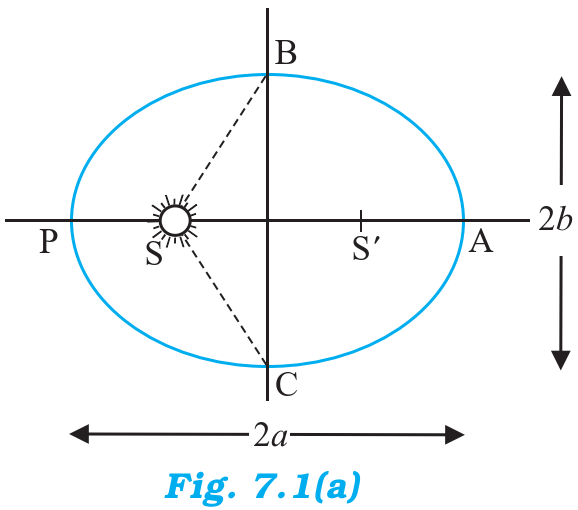
Let the speed of the planet at the perihelion $P$ in Fig. $7.1 (a)$ be $v_p$ and the Sun-planet distance $SP$ be $r_p$ Relate $\left\{r_P, V_P\right\}$ to the corresponding quantities at the aphelion $\left\{r_A, V_A\right\}$. Will the planet take equal times to traverse $\text{B A C}$ and $\text{C P B}$ ?
Image
What would happen to an artificial satellite, if its orbital velocity is slightly decreased due to some defects in it?
A person is standing still on frictionless ice in the middle of a frozen pond, how will be reach the shore?
A transverse harmonic wave on a string is described by
$\text{y}(\text{x, t})=3.0\sin\big(36\text{t}+0.018\text{x}+\frac{\pi}{4}\big)$
where x and y are in cm and t in s. The positive direction of x is from left to right.
What is the initial phase at the origin?
A black metal foil is warmed by radiation from a sphere at temperature T at a distance d. If the power received is P, find the power received when both the temperature and distance are doubled.