Question
Why detergents are better cleansing agents than soaps? Explain.

Answer


A substance capable of removing grease and dirt from any fabric or body is called detergent. The detergents are of two types Le. soapy and non-soapy detergents. The soapy detergents are soaps whereas the non-soapy detergents are synthetic detergents or simply detergents. Although both are cleansing agents, they differ in chemical composition. In the present chapter, we shall briefly discuss the composition and cleansing action of soaps and synthetic detergents.
Soaps are the sodium and potassium salts of long chain fatty acids with general formula RCOONa or RCOOK. The acids present have the formula RCOOH where R may have following values.
$C _{15} H _{31} COOH$
Palmitic acid
$\left(R=C_{15} H_{31}\right)$
$C_{17} H_{33} COOH$
Oleic acid
$\left(R=C_{17} H_{33}\right)$
$C_{17} H_{35} COOH$
$ Stearic acid$
$\left(R=C_{17} H_{35}\right)$
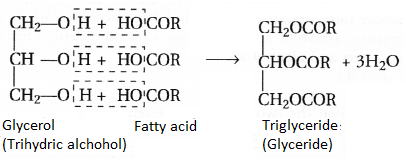
These fatty acids exist as triesters of glycerol which is a trihydric alcohol. The triesters are also called triglycerides or simply glycerides and are the constituents of edible oils and fats. These are of animal and vegetable origin e.g. castor oil, linseed oil or soyabean oil. Chemically the triglycerides are formed as a result of esterification reaction.

Need a full question paper?

Generate a complete, print-ready paper with questions like this in minutes — across 16+ boards, with answer keys.

Start Generating Free

Similar questions

Two organic compounds $A$ and $B$ have the same molecular formula $C _6 H _{12}$. Write the names and structural formulae:
a. If A is a cyclic compound.
b. If $B$ is an open chain compound.
c. Which compound contains single bonds as well as a double bond?
d. Which compound contains only single bonds?
  1. A nerve input signal travelled only up to the spinal cord and gave output signal for a response. What type of action did the body show-voluntary or involuntary?
  2. Draw a nerve pathway for the above action and suggest specific terms for input nerve and output nerve.
A liquid X of colour Y circulates in the human body only in one direction: from body tissues to the heart. Among other things, liquid X contains germs from cells and dead cells. The liquid X is cleaned of germs and dead cells by a special type of white blood cells called Z. This cleaned liquid is then put into blood circulatory system in subclavian veins.
  1. What is (i) liquid X and (ii) colour Y?
  2. What are Z.
  3. The liquid X is somewhat similar to a component of blood. Name this component.
  4. Why is liquid X not red?
In the following crosses write the characteristics of the progeny.
 
Cross
Progeny
a.
RRYY × RRYY
Round, yellow Round, yellow
..............
b.
RrYy × RrYy
Round, yellow Round, yellow
..............
c.
rryy × rryy
wrinkled, green wrinkled, green
..............
d.
RRYY × rryy
Round, yellow wrinkled green
..............
When metal X is treated with a dilute acid Y, then a gas Z is evolved which burns readily by making a little explosion.
  1. Name any two metals which can behave like metal X.
  2. Name any two acids which can behave like acid Y.
  3. Name the gas Z.
  4. Is the gas Z lighter than or heavier than air?
  5. Is the reaction between metal X and dilute acid Y, exothermic or endothermic?
  6. By taking a specific example of metal X and dilute acid Y, write a balanced chemical equation for the reaction which takes place. Also indicate physical states of all the reactants and products.
$(i) '\ A\ '\  '\ B\ '$ are sodium salts of long$-$chain carboxylic acid and long chain Sulphonic acid respectively. Which one of $A$ or $B$ will you prefer as a cleansing agent while using underground water $($hand pump water$)$?
Give the reason for your answer.
$(ii)$ Elaborate on the process of cleansing action. Illustrate micelle with the help of labelled diagram.
$(iii)$ Write the chemical equation of the preparation of soap from an ester
$CH_3COOCH_3$. What is the name of this process?
Which group of elements could be placed in Mendele′ ev's Periodic Table without disturbing the original order? Give reason.
Distinguish between pollination and fertilisation. Mention the site and product of fertilisation in a flower.
Draw a neat, labelled diagram of a pistil showing pollen tube growth and its entry into the ovule.
With the help of a labelled diagram, describe the working of a nuclear power plant.
Compare the properties of ionic compounds and covalent compounds.