Question
Why do stable nuclei never have more protons than neutrons?

Answer

Stable nuclei never have more protons than neutrons because protons are positively charged and repel one another electrically. This repulsion becomes so great in nuclei with more than 10 protons or so, that an excess of neutrons which produce only attractive forces, is required for stability.

Need a full question paper?

Generate a complete, print-ready paper with questions like this in minutes — across 16+ boards, with answer keys.
Start Generating Free

Similar questions

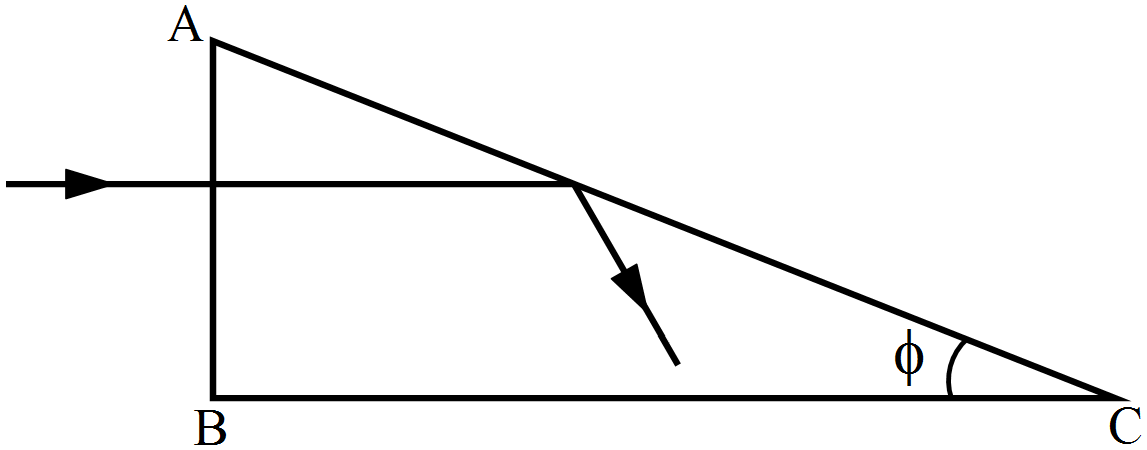
 A light ray is incident normally on the face AB of a right-angled prism ABC $(\mu=1.50)$ as shown in figure. What is the largest angle $\phi$ for which the light ray is totally reflected at the surface AC? 
Calculate the value of electric potential due to a system of charges.
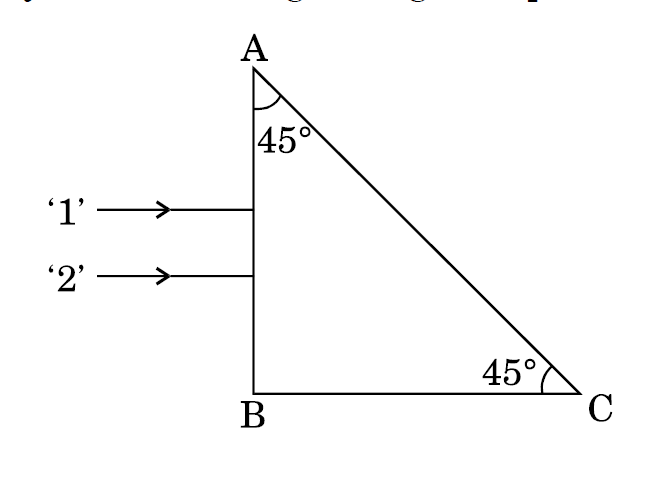
Two monochromatic rays of light are incident normally on the face AB of an isosceles right-angled prism ABC. The refractive indices of the glass prism for the two rays ‘1’ and ‘2’ are respectively 1.35 and 1.45. Trace the path of these rays after entering through the prism.
About $5\%$ of the power of a $100 W$ light bulb is converted to visible radiation. What is the average intensity of visible radiation
  1. at a distance of $1m$ from the bulb?
  2. at a distance of $10 m$?
Assume that the radiation is emitted isotropically and neglect reflection.
Two monochromatic rays of light are incident normally on the face AB of an isosceles right-angled prism ABC. The refractive indices of the glass prism for the two rays ‘1’ and ‘2’ are respectively 1.3 and 1.5 Trace the path of these rays after entering through the prism.
a. It is not advisable to use a galvanometer as such to measure current directly. Why?
b. Why should the value of resistance connected in parallel to a galvanometer be low?
c. Is the reading shown by an ammeter in a circuit less than or more than the actual value of current flowing in the circuit? Why?
Two electric charges $+Q$ and $-Q(x-y)$ are placed at the points $\left(-x_2, 0\right)$ and $\left(x_1, 0\right)$ respectively in the plane. Find the magnitude and direction of the resultant electric field at the origin $(0,0)$.
Define the term ‘power loss’ in a conductor of resistance R carrying a current I. In what form does this power loss appear? Show that to minimise the power loss in the transmission cables connecting the power stations to homes; it is necessary to have the connecting wires carrying current at enormous high values of voltage.
The charge on a proton is $+1.6 \times 10^{-19}C$ and that on an electron is $-1.6 \times 10^{-19}C.$ Does it mean that the electron has a charge $3.2 \times 10^{-19}C$ less than the charge of a proton?
The coil of a moving-coil galvanometer keeps on oscillating for a long time if it is deflected and released. If the ends of the coil are connected together, the oscillation stops at once. Explain