Question
Why do we keep both snake and turtle in the same class?

Answer

Snake and turtle belong to same class-Reptilia. They are kept in same class because both:
  1. Are cold-blooded.
  2. Have scales as outer covering.
  3. Have lungs for breathing.
  4. Have three-chambered heart.
  5. lay eggs with tough outer covering.
  6. Fertilisation is internal.

Need a full question paper?

Generate a complete, print-ready paper with questions like this in minutes — across 16+ boards, with answer keys.
Start Generating Free

Similar questions

By which physical process the fragrance of burning an incense stick spreads all around?
Which of the following are matter? Chair, air, love, smell, hate, almonds, thought, cold, lemon water, smell of perfume.
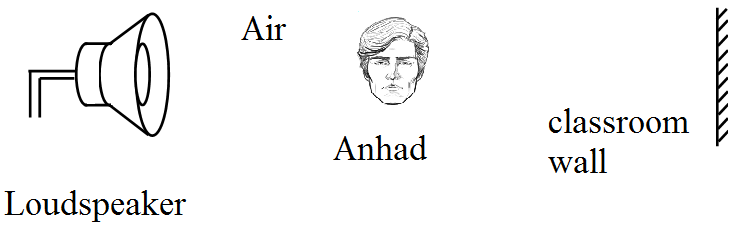
In an experiment, Anhad studies sound waves. He sets up a loudspeaker to produce sound as shown below:
Anhad adjusts the signal to the loudspeaker to give a sound of frequency 200Hz.
  1. What happens to the air in-between Anhas and the loudspeaker?
  2. Explain how Anhad receives sound in both ears.
How will you determine the melting point of ice experimentally with the help of a neat and labelled diagram?
The weight of any person on the moon is about 1/6 times that on the earth. He can lift a mass of 15 kg on the earth. What will be the maximum mass, which can be lifted by the same force applied by the person on the moon?
What is osmosis?
A train travels the first 15km at a uniform speed of 30 km/h; the next 75km at a uniform speed of 50km/h; and the last 10km at a uniform speed of 20km/h.
Calculate the average speed for the entire train journey.
Three different vibrating objects produce three types of sounds $X$, $Y$ and $Z$. Sounds $X$ and $Y$ cannot be heard by a man having normal range of hearing but sound $Z$ can be heard easily. The sound $X$ is used in hospitals to break kidney stones of a patient into fine grains whioch then get flushed out with urine. The sound $Y$ is similar to that which is produced during an earthquake before the main shock wave is generated.
  1. What t$Y$pe of sounds are $(i) X, (ii) Y$, and $(iii) Z$?
  2. Name one device which can produce sound like $X$.
  3. Name one device in a science laboratory which can produce sound like $Y$.
  4. Name one device in our homes which can produce sound like $Z$.
  5. What is the frequency range of sounds like $Z$?
Why are we able to sip hot tea or milk faster from a saucer rather than from a cup?
Which has more atoms, $50g $ of aluminium or $50g$ of iron$?$ Illustrate your answer with the help of calculations.
$($Atomic masses: $Al = 27u; Fe = 56u)$