Question
Why do we need a proper transportation system in plants?

Answer

Plants need vascular bundles for transport the food, minerals and water. When water and minerals are absorbed by the roots, then this cannot be direct reach to the upper parts of plants. So xylem tissue takes them and transport it to the upper part of plant like shoot, stem and mainly for leaves for preparing food by photosynthesis. If roots do work of absorption of water and minerals then it also needs energy. For example if we do any work then we need energy to do that work. It is same with the roots. They need their food for energy. When leaves do photosynthesis and form food, then this cannot directly get by the roots. So phloem is used for transporting the food from leaves to roots. Hence plants need transporting system. But bryophtes do not need this system because they are thallophytes.

Need a full question paper?

Generate a complete, print-ready paper with questions like this in minutes — across 16+ boards, with answer keys.

Start Generating Free

Similar questions

A metal X which is resistant to corrosion is produced by the electrolysis of its molten oxide whereas another metal Y which is also resistant to corrosion is produced by the reduction of its oxide with carbon. Metal X can be used in powder form in thermite welding whereas metal Y is used in making cathodes of ordinary dry cells.
  1. Name the metals X and Y.
  2. Which of the two metals is more reactive : X or Y?
  3. Name one ore or metal X. Also write its chemical formula.
  4. Name one ore of metal Y. Also write its chemical formula.
  5. Name one alloy of metal X and one alloy of metal Y.
Define ‘speciation’. Explain how speciation occurs.
Explain the following.
1. Reactivity of Al decreases if it is dipped in $HNO _3$.
2. Carbon cannot reduce the oxides of Na or Mg .
3. NaCl is not a conductor of electricity in solid state whereas it does conduct electricity in aqueous solution as well as in molten state.
4. Iron articles are galvanised.
5. Metals like $Na , K , Ca$ and Mg are never found in their free state in nature.
The germ cell A produced by a person X is round in shape and it fuses with another germ cell B having a long tail and produced by a person Y. The fusion of A and B produces a new cell C. The cell C divides repeatedly and grows inside the organ D of person X to form E in which the body features of the unborn baby are not much developed. E grows further to form F in which the various body features of the unborn baby (like hands, legs, head, eyes, and ears, etc.) can be identified. F grows further and ultimately forms a baby. What are A, B, C, D, E and F? Out of the two persons X and Y, which one is male and which one female?
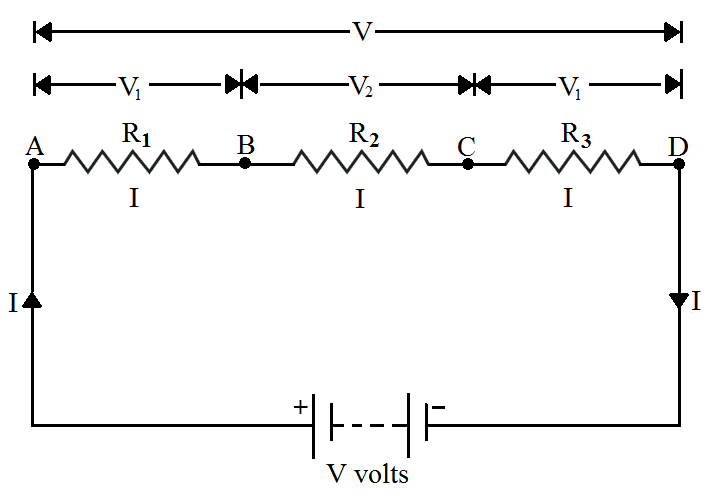
For the circuit shown in the diagram given below:
Calculate:
  1. The value of current through each resistor.
  2. The total current in the circuit.
  3. The total effective resistance of the circuit.
  1. What is a soap? Why are soaps not suitable for washing clothes when the water is hard?
  2. Explain the action of soap in removing an oily spot from a piece of cloth.
Suppose you have three concave mirrors A, B and C of focal lengths 10cm, 15cm and 20cm. For each concave mirror, you perform the experiment of image formation for three values of object distance of 10cm, 20cm and 30cm. Giving reason answer the following:
  1. For the three object distances, identify the mirror/ mirrors which will form an image of magnification - 1.
  2. Out of the three mirrors identify the mirror which would be preferred to be used for shaving purposes/ makeup.
  3. For the mirror B draw, ray diagram for image formation for object distances 10cm and 20cm.
  1. If the image formed by a lens is diminished in size and erect, for all positions of the object, what type of lens is it?
  2. Name the point on the lens through which a ray of light passes undeviated.
  3. An object is placed perpendicular to the principal axis of a convex lens of focal length 20cm. The distance of the object from the lens is 30cm. Find,
  1. The position.
  2. The magnification.
  3. The nature of the image formed.
Give the various functions of brain.
Name the scientist who gave the theory of origin of life on earth. What is this theory?