MCQ
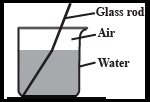
Why does a straight rod appear bent in water?
  • A
    Due to reflection of light
  • Due to refraction of light
  • C
    Due to variable refractive index of water.
  • D
    None of the above

Answer

Correct option: B.
Due to refraction of light

This phenomenon occurs due to the property of light called refraction of light. When a stick is immersed in water, in actually we are putting it from rarer medium to denser medium. So, when the rays of light pass from a rarer medium to the denser medium they move towards the normal, the part of stick immersed in water appears to bend when immersed in water and this refraction causes an apparent shift in the position of the part of the rod within the water.
Need a full question paper?

Generate a complete, print-ready paper with questions like this in minutes — across 16+ boards, with answer keys.
Start Generating Free

Similar questions

Three long concentric conducting cylindrical shells have radii $R, 2R$ and $2\sqrt 2 $ $ R$ . Inner and outer shells are connected to each other. The capacitance across middle and inner shells per unit length is: 
The electric potential varies in space according to the relation $V = 3x + 4y$. A particle of mass $0.1\,\, kg$ starts from rest from point $(2, 3·2)$ under the influence of this field. The charge on the particle is $+1\,\, μC$. Assume $V$ and $(x, y)$ are in $S.I.$ $units$ . The time taken to cross the $x-$ axis is.....$s$
Electric field and magnetic field in Thomson mass spectrograph are applied
In the middle of the depletion layer of a reverse-biased $PN$ junction, the
Assertion : The energy $(E)$ and momentum $(p)$ of a photon are related by $p = E/c$.
Reason : The photon behaves like a particle.
A metal wire has a resistance of $35 \,\Omega$. If its length is increased to double by drawing it, then its new resistance will be (in $\Omega$)
The equation of an equipotential line in an electric field is $y = 2x$, then the electric field strength vector at $(1, 2)$ may be
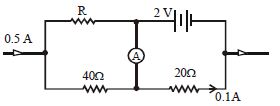
In the circuit shown in the figure, no current flows through the ideal ammeter. If the internal resistance of the cell is negligible, the value of unknown resistance $R $ is .............. $\Omega$
When yellow light is incident on a surface, no electrons are emitted while green light can emit. If red light is incident on the surface, then
Two slits are made one millimetre apart and the screen is placed one metre away. What is the fringe separation (in $mm$) when bluegreen light of wavelength $500\; nm$ is used?