Question
Why does hard water not form lather with soap?

Answer

Soap is sodium or potassium salt of fatty acid. it is made up when alkali reacts with fatty acids. hardness of water is due to calcium and magnesium ions. sodium salts dissolve in water and hence lather is formed when soap is added to hard water, calcium and magnesium ions replaces sodium (or potassium) ions in the salt (soap) and gets precipitated hence lather formation is hindered.

Need a full question paper?

Generate a complete, print-ready paper with questions like this in minutes — across 16+ boards, with answer keys.

Start Generating Free

Similar questions

An ideal gas is allowed to expand against a constant pressure of 2 bar from 10L to 50L in one step. Calculate the amount of work done by the gas. If the same expansion were carried out reversibly, will the work done be higher or lower than the earlier case? (Given that 1L bar = 100J)
Explain:
  1. Boron is unable to form $\text{BF}^{3-}_6$ ion.
  2. $[\text{SiF}_6]^{2-}$ is known whereas $[\text{SiCl}_6]^{2-}$ is not known.
  3. Conc. $\mathrm{HNO}_3$ can be stored in aluminium container.
How oxides of nitrogen are generated? What are harmful effects of oxides of nitrogen?
Draw the shape of the following hybrid orbitals $\mathrm{sp}$,  $\mathrm{sp}^2$ and $\mathrm{sp}^3$.
Give the structures of A and B.
Find out the value of $\text{K}_{\text{c}}$ for each of the following equilibria from the value of $\text{K}_{\text{p}}$:
$2\text{NOCl (g)}\rightleftharpoons2\text{NO (g) + Cl}_2\text{ (g)};\text{ k}_{\text{p}}=1.8\times10^{-2}\text{ at }500\text{K}$
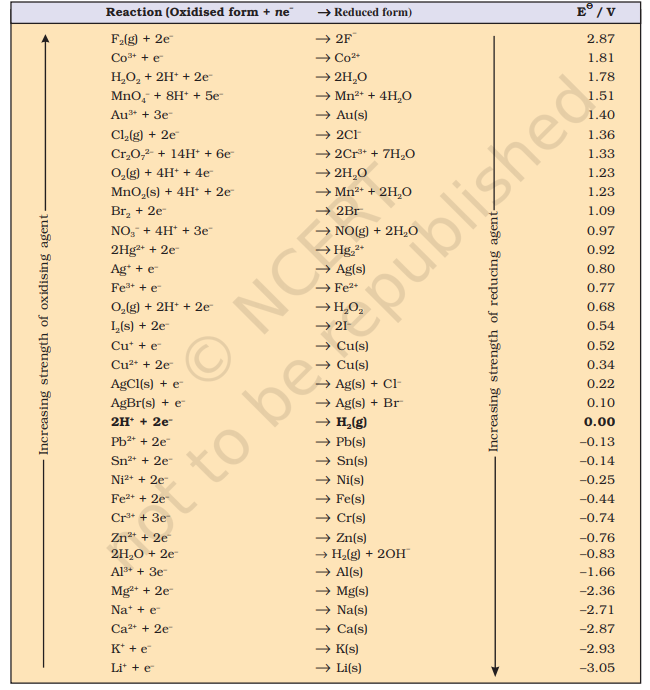
Using the standard electrode potentials given in the Table, predict if the reaction between the following is feasible:

$\mathrm{Br}_2(\mathrm{aq})$ and $\mathrm{Fe}^{2+}(\mathrm{aq})$.
The density of 3 molal solution of NaOH is $1.110 \mathrm{~g} \mathrm{~mL}^{-1}$. Calculate the molarity of the solution.
  1. How does Ionic radii vary with effective nuclear charge? Give example.
  2. An element belongs to 3rd period and group-13 of the periodic table. Identify the element and write two properties of element.
Select from each group of species which has the smallest radius stating the appropriate reason:
$\text { i. } \mathrm{O}, \mathrm{O}^{-}, \mathrm{O}^{2-}$
$\text { ii. } \mathrm{K}^{+}, \mathrm{Sr}^{2+}, \mathrm{Ar}$
$\text { iii. } \mathrm{Si}, \mathrm{P}, \mathrm{Cl}$