Question
Why don't we have interference when two candles are placed close to each other and the intensity is seen at a distant screen? What happens if the candles are replaced by laser sources?

Answer

In order to get interference, the sources should be coherent, i.e. they should emit wave of the same frequency and a stable phase difference. Two candles that are placed close to each other are distinct and cannot be considered as coherent sources. Two independent sources cannot be coherent. So, two different laser sources will also not serve the purpose.

Need a full question paper?

Generate a complete, print-ready paper with questions like this in minutes — across 16+ boards, with answer keys.
Start Generating Free

Similar questions

A small object is embedded in a glass sphere $(\mu=1.5)$ of radius 5.0cm at a distance 1.5cm left to the centre. Locate the image of the object as seen by an observer standing.
  1. To the left of the sphere.
  2. To the right of the sphere.
Resistance of tungsten filament in one bulb at $27{ }^{\circ} C$ is $18 \Omega$. When this bulb is connected to 60 V source, steady current passing through it is 0.3 A . Find temperature of this filament taking $\alpha=4.5 \times 10^{-3} K^{-1}$. Assume that Ohm's law is obeyed.
TV signals broadcast by Delhi studio cannot be directly received at Patna which is about 1000km away. But the same signal goes some 36000km away to a satellite, gets reflected and is then received at Patna. Explain.
If the radius of a circular current carrying coil is doubled and the current flowing through it is reduced to half, then what will be effect on magnetic moment?
A person is standing on a weighing machine placed on the floor of an elevator. The elevator starts going up with some acceleration, moves with uniform velocity for a while and finally decelerates to stop. The maximum and the minimum weights recorded are 72kg and 60kg. Assuming that the magnitudes of the acceleration and the deceleration are the same, find:
  1. The true weight of the person.
  2. The magnitude of the acceleration. Take g = 9.9m/s2.
​​​​​​​
The radius of a thin hollow metal sphere (spherical shell) is 30 cm . And there is a charge of 500 $\mu C$ on that spherical shell. Find the electric field intensity at a distance.(i) 1 meter, (ii) 30 cm , (iii) 10 cm , from the centre of the cell.
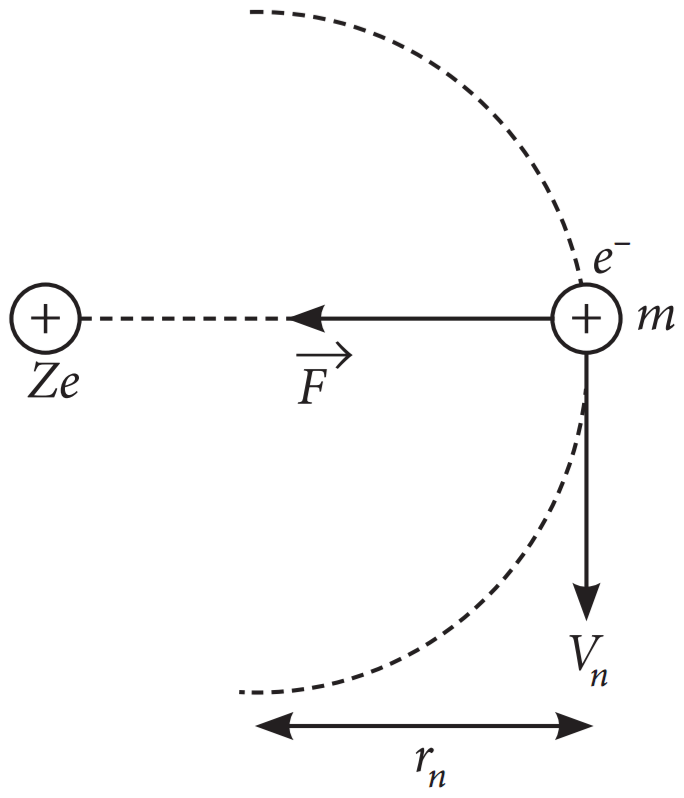
Hydrogen is the simplest atom of nature. There is one proton in its nucleus and an electron moves around the nucleus in a circular orbit. According to Niels Bohr, this electron moves in a stationary orbit. When this electron is in the stationary orbit, it emits no electromagnetic radiation.The angular momentum of the electron is quantized, i.e., ⁣$\text{mvr}=\big(\frac{\text{nh}}{2\pi}\big)$ where m = mass of the electron, v = velocity of the electron in the orbit, r = radius of the orbit and n = 1, 2, 3, .... When transition takes place from Kth orbit to Jth orbit, energy photon is emitted. If the wavelength of the emitted photon is $\lambda$ we find that $\frac{1}{\lambda}=\text{R}\bigg[\frac{1}{\text{J}^2}-\frac{1}{\text{K}^2}\bigg]$where find that On a different planet, the hydrogen atom's structure was somewhat different from ours. The angular momentum of electron was $\text{P}=2\text{n}\Big(\frac{\text{h}}{2\pi}\Big)$ i.e., an even multiple of $\Big(\frac{\text{h}}{2\pi}\Big)$.

  1. The minimum permissible radius of the orbit will be.
  1. $\frac{2\in_0\text{h}^2}{\text{m}\pi\text{e}^2}$
  2. $\frac{4\in_0\text{h}^2}{\text{m}\pi\text{e}^2}$
  3. $\frac{\in_0\text{h}^2}{\text{m}\pi\text{e}^2}$
  4. $\frac{\in_0\text{h}^2}{\text{2m}\pi\text{e}^2}$
  1. In our world, the velocity of electron is v0 when the hydrogen atom is in the ground state. The velocity of electron in this state on the other planet should be.
  1. $\text{v}_0$
  2. $\frac{\text{v}_0}{2}$
  3. $\frac{\text{v}_0}{4}$
  4. $\frac{\text{v}_0}{8}$
  1. In our world, the ionization potential energy of a hydrogen atom is 13.6eV. On the other planet, this ionization potential energy will be.
  1. 13.6eV
  2. 3.4eV
  3. 1.5eV
  4. 0.85eV
  1. Check the correctness of the following statements about the Bohr model of hydrogen atom.
  1. The acceleration of the electron in n = 2 orbit is more than that in n = 1 orbit.
  2. The angular momentum of the electron in n = 2 orbit is more than that in n = 1 orbit.
  3. The kinetic energy of the electron in n = 2 orbit is less than that in n = 1 orbit.
  1. Only (III) and (I) are correct
  2. Only (III) and (I) are correct
  3. Only (II) and (III) are correct.
  4. All the statements are correct.
  1. In Bohr's model of hydrogen atom, let PE represent potential energy and TE the total energy. In going to a higher orbit.
  1. PE increases, TE decreases
  2. PE decreases, TE increases
  3. PE increases, TE increases
  4. PE decreases, TE decreases
Electrons oscillating in a circuit give rise to radiowaves. A transmitting antenna radiates most effectively the radiowaves of wavelength equal to the size of the antenna. The infrared waves incident on a substance set into oscillation all its electrons, atoms and molecules. This increases the internal energy and hence the temperature of the substance.
  1. If vg, vx and vm are the speeds of gamma rays, X-rays and microwaves respectively in vacuum, the
  1. vg > vx > vm
  2. vg < vx < vm
  3. vg > vx > vm
  4. vg = vx = vm
  1. Which of the following wi II deflect in electric field?
  1. X-rays.
  2. $\gamma-\text{rays}.$
  3. Cathode rays.
  4. Ultraviolet rays.
  1. $\gamma-\text{rays}$ are detected by:
  1. Point contact diodes.
  2. Thennopiles.
  3. Ionization chamber.
  4. Photocells.
  1. The frequency of electromagnetic wave, which best suited to observe a particle ofradius 3 × 10⁻⁴cm is the order of,
  1. 1015Hz
  2. 1014 Hz
  3. 1013Hz
  4. 1012Hz
  1. We consider the radiation emitted by the human body. Which one of the following statements is true?
  1. The radiation emitted is in the infrared region.
  2. The radiation is emitted only during the day.
  3. The radiation is emitted during the summers and absorbed during the winters.
  4. The radiation emitted lies in the ultraviolet region and hence it is not visible.
A magnetic dipole of magnetic moment 1.44A-m2 is placed horizontally with the north pole pointing towards north. Find the position of the neutral point if the horizontal component of the earth's magnetic field is $18 \mu\text{T}.$
Refraction of light is the change in the path of light as it passes obliquely from one transparent medium to another medium. According to law of refraction $\frac{\sin\text{i}}{\sin\text{r}}=\ ^1\mu_2,$ where $^1\mu_2$ is called refractive index of second medium with respect to first medium. From refraction at a convex spherical surface, we have $\frac{\mu_2}{\text{v}}=\frac{\mu_1}{\text{u}}=\frac{\mu_2-\mu_1}{\text{R}}.$ Similarly from refraction at a concave spherical surface when object lies in the rarer medium, we have $\frac{\mu_2}{\text{v}}-\frac{\mu_1}{\text{u}}=\frac{\mu_2-\mu_1}{\text{R}}$ and when object lies in the denser medium, we have $\frac{\mu_1}{\text{v}}-\frac{\mu_2}{\text{u}}=\frac{\mu_1-\mu_2}{\text{R}}.$
  1. Refractive index of a medium depends upon:
  1. Nature of the medium.
  2. Wavelength of the tight used.
  3. Temperature.
  4. All of these.
  1. A ray of light of frequency 5 × 1014Hz is passed through a liquid. The wavelength of light measured inside the liquid is found to be 450 × 10-9m. The refractive index of the liquid is:
  1. 1.33
  2. 2.52
  3. 2.22
  4. 0.75
  1. A ray of light is incident at an angle of 60º on one face of a rectangular glass slab of refractive index 1.5. The angle of refraction is:
  1. $\sin^-1 (0.95)$
  2. $\sin^-1 (0.58)$
  3. $\sin^-1 (0.79)$
  4. $\sin^-1 (0.86)$
  1. A point object is placed at the centre of a glass sphere of radius 6 cm and refractive index 1.5. The distance of the virtual image from the surface of sphere is:
  1. 2cm
  2. 4cm
  3. 6cm
  4. 12cm
  1. In refraction, light waves are bent on passing from one medium to the second medium because in the second medium:
  1. The frequency is different.
  2. The co-efficient of elasticity is different.
  3. The speed is different.
  4. The amplitude is smaller.