Question
Why electron withdrawing groups such as $- NO_2$ show their effect only at $O$ and $P -$ position and not at $m -$ position.

Answer

Image
Image
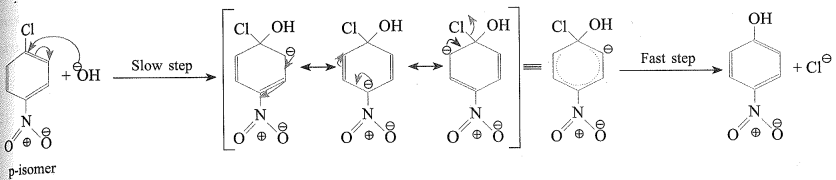
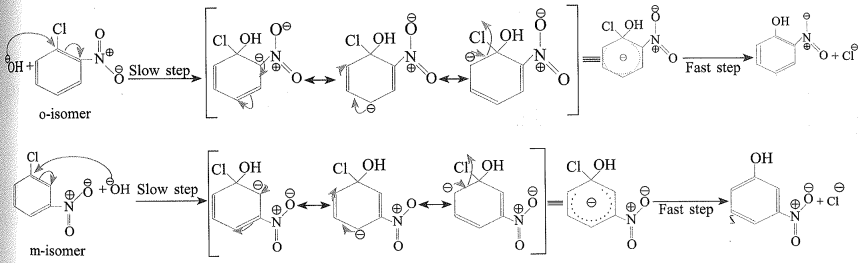
$\rightarrow$ As shown, the presence of nitro group at ortho$-$ and para$-$positions withdraws the electron density from the benzene ring and thus facilitates the attack of the nucleophile on haloarene.
$\rightarrow$ The carbanion thus, formed is stabilised through resonance.
$\rightarrow$ The negative charge appeared at ortho $-$ and para positions with respect to the halogen substituent is stabilised by $-NO_2$ group while in case of meta$-$nitrobenzene, none of the resonating structures bear the negative charge on carbon atom bearing the $-NO_2$ group.
$\rightarrow$ Therefore, the presence of nitro group at meta$-$position does not stabilise the negative charge and no effect on reactivity is observed by the presence of $-NO_2$ group at meta$-$position.

Need a full question paper?

Generate a complete, print-ready paper with questions like this in minutes — across 16+ boards, with answer keys.
Start Generating Free

Similar questions

$SnO_2$ forms a positively charged colloidal sol in acidic medium and a negatively charged sol in the basic medium. Why? Explain.
Write the mechanism of acid dehydration of ethanol to yield ethane.
How the following conversions can be carried out?
i. 2-Bromopropane to 1-bromopropane
ii. Chloroethane to butane
iii. Benzene to diphenyl
E° values of Mn, Ni and Zn are more negative than expected.
Answer the following questions:
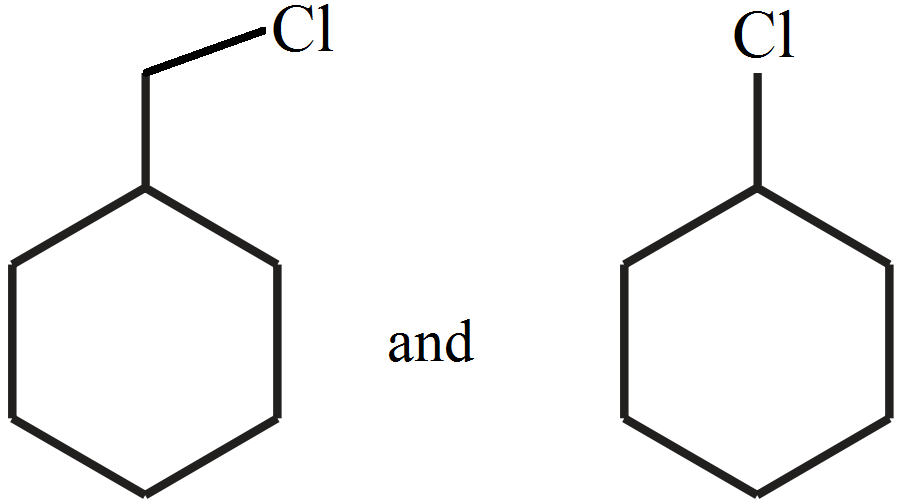
In the following pairs of halogen compounds, which would undergo $S_N1$ reaction faster? Explain.
Discuss the formation of amine compounds by reduction of nitrile and amide compounds.
Write structures of compounds A, B and C in each of the following reactions:
  1. $ \text{C}_6\text{H}_5\text{Br}\xrightarrow{\text{Mg/dry ether}}\text{A}\xrightarrow[(b )\text{ }\text{H}_3\text{O}^+]{(a)\text{ }\text{Co}_{2\text{(g)}}}\text{B}\xrightarrow{\text{PC}l_5}\text{C}$
  2. $ \text{C}\text{H}_3\text{CN}\xrightarrow[(b )\text{ }\text{H}_3\text{O}^+]{(a)\text{ }\text{SnC}l_{2}/\text{HC}l}\text{A}\xrightarrow{\text{dil.NaOH}}\text{B}\xrightarrow{\text{ }\text{ }\text{ }\text{ }\text{ }\triangle\text{ }\text{ }\text{ }\text{ }\text{ }\text{ }\text{ }\text{ }}\text{C}$
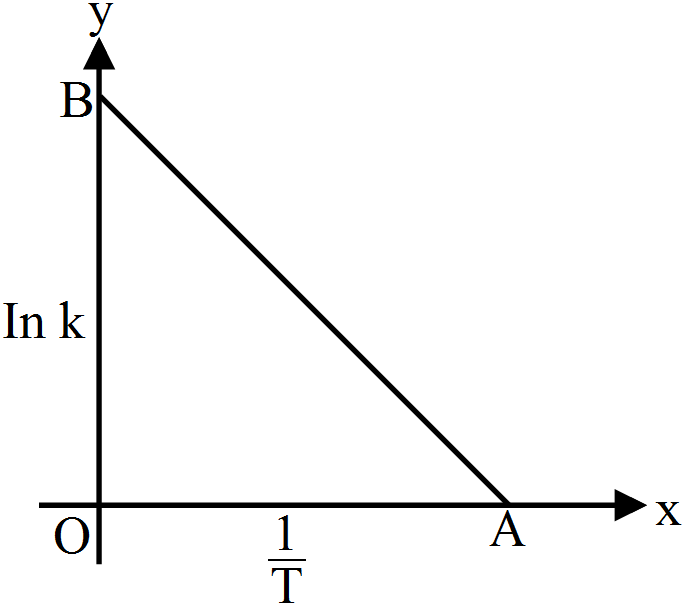
A graph between ln $k$ and $\frac{1}{\text{t}}$ for a reaction is given. Here k is rate constant and $T$ is temperature in Kelvin.If $OA = a$ and $OB = b,$ answer the following:
  1. What is the activation energy $(Ea)$ of the reaction?
  2. What is the frequency factor $(A)$ for the reaction?
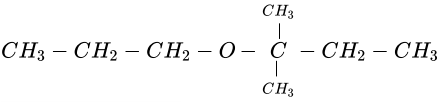
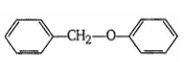
Give the major products that are formed by heating each of the following ethers with HI.
Image
Image
Image
The electrical resistance of a column of $0.05 M$ KOH solution of diameter $1 cm$ and length $45·5 cm$ is $4.55 \times$ $10^3$ ohm. Calculate its molar conductivity.