Question
Why fixed assets are not shown in the books at market value?

Answer

Fixed assets are not shown in the books at market value because:
  1. As per historical concept, we record fixed assets at original cost, and.
  2. As per going concern concept, the assets are not going to be sold in the near future. Hence, the market value is irrelevant.

Need a full question paper?

Generate a complete, print-ready paper with questions like this in minutes — across 16+ boards, with answer keys.

Start Generating Free

Similar questions

“In case of a long term asset, repair and maintenance expenses are expected to rise in later years than in earlier year”. Which method is suitable for charging depreciation if the managernent does not want to increase burden on Profit & Loss Account on account of depreciation and repair.
Describe the events recorded in accounting systems and the importance of source documents in those systems?
On 31st March, 2019, the balance as per the Bank Statement was ₹ 10,000 debit. On the same date, outstanding cheques amounted to ₹ 30,000 and outstanding deposits amounted to ₹ 50,000. Also, there was a dishonoured cheque from a customer of ₹ 5,000 recorded in the Bank Statement but not in the Cash Book. On the basis of the above information, determine the balance as per the Cash Book.
Explain the meaning of the following term:
Business Transaction.
Prepare Journal from the transactions given below:
 
 
(a)
Cash paid for installation of machine
500
(b)
Goods given as charity
2,000
(c)
Interest charge on capital @ 7% p.a. when total capital were
70,000
(d)
Received ₹ 1,200 of a bad debts written-off last year.
 
(e)
Goods destroyed by fire
2,000
(f)
Rent outstanding
1,000
(g)
Interest on drawings
900
(h)
Sudhir Kumar who owed me ₹ 3,000 has failed to pay the amount. He pays me a compensation of 45 paise in a rupee.
 
(i)
Commission received in advance
7,000
Prove that the Accounting Equation is satisfied in all the following transactions of Rajaram. Also prepare a Balance Sheet:
  1. Started business with Cash ₹ 1,20,000.
  2. Purchased a typewriter for Cash for ₹ 8,000 for office use.
  3. Purchased goods for ₹ 50,000 for cash.
  4. Purchased goods for ₹ 40,000 on credit.
  5. Goods costing ₹ 60,000 sold for ₹ 80,000 on credit.
  6. Paid for Rent ₹ 1,500 and for salaries ₹ 2,000.
  7. Received ₹ 800 for Commission.
  8. Withdrew for private use ₹ 5,000 in cash.
Determine, if the following are Assets, Liabilities, Capital, Revenue from Operations, Revenues, Expenses or none:
a. Machinery
b. Purchases
c. Stock
d. Creditors
e. Capital
f. Salary paid to a clerk
g. Sales
h. Furniture
i. Interest received and
j. Rent paid
Journalise the following transactions:
i. Goods destroyed by fire for Rs 4,500
ii. Paid Rs 1,500 in cash as wages on the installation of machinery
iii. Issue a cheque in favour of M/s. Parmatma Saran & Sons on accounts of purchase of goods Rs 7,500
iv. Goods sold costing Rs 6,000 of M/s. Kalu sons at an invoice price of 10% above cost less 5% Trade Discount.
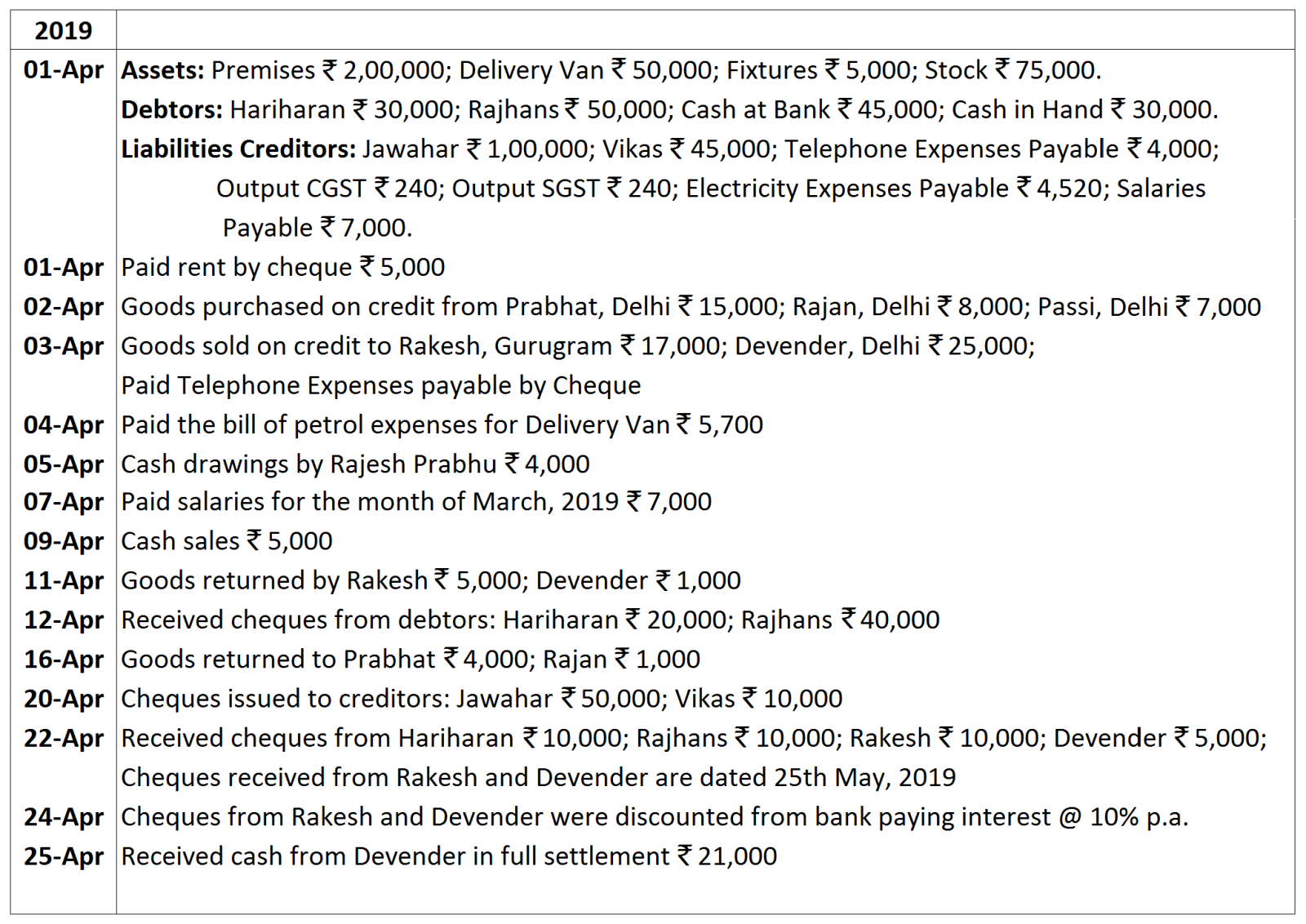
You are to open the books of Rajesh Prabhu, Gurugram (Haryana) a trader, through the Journal to record the assets and liabilities and then post the transactions to the Ledger for the month of April, 2019.
Inter-state transactions are subject to levy of IGST @ 12% and Intra-state transactions are subject to levy of CGST and SGST @ 6% each. GST is not levied on transactions marked with (*).
Pass Journal entries in the books of Hari Shankar & Co. from the following:
2017
 
April 1
Commenced business with cash
50,000
April 2
Purchased goods from Subhash
20,000
April 4
Sold goods to Ramnath
15,000
April 6
Ramnath returned defective goods
1,000
April 10 Received cash from Ramnath and 13,800
Discount allowed 200
April 12
Gopal sold goods to us
10,000
April 14
Paid to Gopal in full settlement of his account after deducting 5% discount
 
April 15
Paid Rent
10,000
April 16
Paid Rent of Hari Shankar's residence
5,000
April 18
Purchased goods for cash from Govind for ₹ 6,000 at 20% trade discount
 
April 20
Purchased goods from Govind for ₹ 10,000 at 20% trade discount
 
April 24
Paid to Govind ₹ 7,850 in full settlement of his account
 
April 25
Paid to Subhash ₹ 4,750 discount received ₹ 250
 
April 30
Paid wages ₹ 400, Salaries ₹ 4,000, Advertisement expenses ₹ 800 and Trade expenses ₹ 1,000