Question
Why is a potentiometer preferred over a voltmeter for measuring emf?

Answer

A voltmeter should have an infinite resistance so that it draws no current from the circuit. A voltmeter, on the other hand, cannot be designed to have infinite resistance. At the null point, a potentiometer draws no current from the circuit. It provides a more accurate measurement. As a result, it serves as an ideal voltmeter.

Need a full question paper?

Generate a complete, print-ready paper with questions like this in minutes — across 16+ boards, with answer keys.
Start Generating Free

Similar questions

Describe the construction and working of a transformer with a neat labelled diagram.
Explain how a moving-coil galvanometer is converted into a voltmeter. Derive the necessary formula.
In a hydraulic lift, the input piston had surface area $30 cm ^2$ and the output piston has surface area of $1500 cm ^2$. If a force of $25 N$ is applied to the input piston, calculate weight on output piston.
State the characteristics of blackbody radiation spectrum.
State the MI of a thin rectangular plate-of mass M, length l and breadth b about its transverse axis passing through its centre. Hence find its MI about a parallel axis through the midpoint of edge of length b.
On the basis of the kinetic theory of gases, derive an expression for the pressure exerted by the gas.
Explain how a potentiometer is used as a voltage divider.
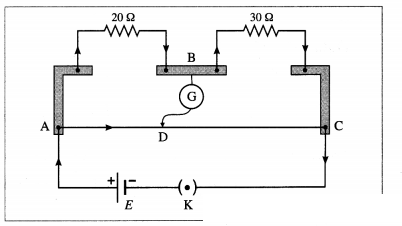
Two resistances, $20 \Omega$ and $30 \Omega$, are connected across the two gaps of a metre bridge as shown in the following figure.
Image
The bridge wire has diameter $0.5\ mm$ and resistance $2 \Omega$. The emf of the cell is $2 V$. Assume that the internal resistance of the cell is zero. Calculate $(I)$ the resistivity $($specific resistance$)$ of the material of the bridge wire $(ii)$ the current provided by the cell when the bridge is balanced.
Find the ratio of the potential differences that must be applied across the parallel and series combination of two capacitors C1 and C2 with their capacitances in the ratio 1 : 2, so that the energy stored in these two cases becomes the same.
Prove that the kinetic energy per molecule of an ideal gas is $\frac{3}{2} \mathrm{~K}_{\mathrm{B}} \mathrm{T}$.
Give the interpretation of temperature according to the kinetic theory of gases.