Question
Why is anode negatively charged in an electrochemical cell?

Answer

At anode, loss of electrons takes place, i.e. oxidation takes place, electron density is more, hence anode is negatively charged.

Need a full question paper?

Generate a complete, print-ready paper with questions like this in minutes — across 16+ boards, with answer keys.
Start Generating Free

Similar questions

  1. Which out of $TICl_3$, GaCl, InCl, TICl undergo disproportionation reaction and why?
  2. Why is boric acid used in carom boards for smooth gliding of pawns.
Which out of Li, Na, K, Be, Mg, Ca has lowest ionisation enthalpy and why?
Image
On the basis of intermolecular forces and thermal energy, explain why?
  1. A solid has rigidity but liquids do not have rigidity?
  2. Gases have high compressibility but liquids and solids have poor compressibility?
$\text{N}_2(\text{g})+3\text{H}_2(\text{g})\rightleftharpoons2\text{NH}_3(\text{g});$
$\text{K}=0.50\text{ at }673\text{K.}$
Write the equilibrium expression and equilibrium constant for reverse reaction.
Standard vaporisation enthalpy of benzene at boiling point is $30.8 \mathrm{~kJ} \mathrm{~mol}^{-1}$. For how long would 100 W electric heater have to operate in order to vaporise a 100 g sample at that temperature (power = energy/ time and $1 \mathrm{~W}=1 \mathrm{~J} \mathrm{~s}^{-1}$ )?
18.0 g of water completely vapourises at $100^{\circ} \mathrm{C}$ and 1 bar pressure and the enthalpy change in the process is 40.79 kJ $\mathrm{mol}^{-1}$. What will be the enthalpy change for vapourising two moles of water under the same cond tions? What is the standard enthalphy of vapourisation for water?
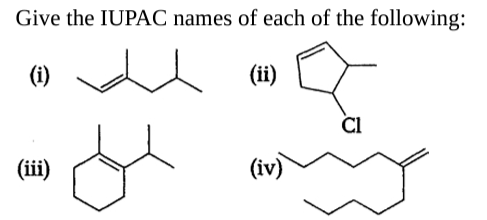
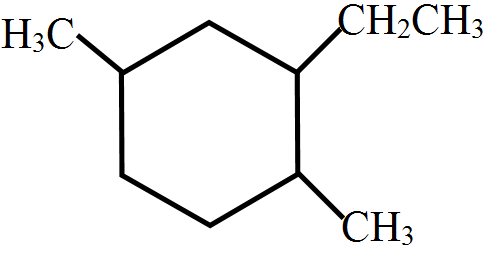
Give IUPAC name of the following:
  1.  
$\ \ \ \ \ \ \ \ \ \ \ \ \stackrel{8\ \ \ \ }{\text{CH}_2}-\stackrel{9\ \ \ \ }{\text{CH}_3}\ \ \ \ \ \ \ \ \ \ \ \ \ \text{CH}_3\ \ \ \text{CH}_2-\text{CH}_3\\\ \ \ \ \ \ \ \ \ \ \ \ \ \ |\ \ \ \ \ \ \ \ \ \ \ \ \ \ \ \ \ \ \ \ \ \ \ \ \ \ \ \ \ \ \ \ \ \ |\ \ \ \ \ \ \ \ \ | \\\text{CH}_3-\text{CH}-\text{CH}_2-\text{CH}_2-\text{CH}-\text{CH}-\text{CH}_2-\text{CH}_3\\\ \ \ \ \ \ \ \ \ \ \ \ \ \ ^{7\ \ \ \ \ \ \ \ \ \ \ \ \ 6\ \ \ \ \ \ \ \ \ \ \ \ \ \ \ 5\ \ \ \ \ \ \ \ \ \ \ \ \ \ \ 4\ \ \ \ \ \ \ \ \ \ \ \ \ \ \ 3\ \ \ \ \ \ \ \ \ \ \ \ \ \ \ 2\ \ \ \ \ \ \ \ \ \ \ \ \ \ 1}$
  1.  
The enthalpy of vapourisation of a liquid is $30 \mathrm{~kJ} \mathrm{~mol}^{-1}$ and entropy of vapourisation $75 \mathrm{JK}^{-1} \mathrm{~mol}^{-1}$. Calculate the boiling point of liquid at 1atm.
Bromine has two isotopes ${ }^{79} Br$ and ${ }^{81} Br$ whose percentage amounts are 49.7 and 50.3 respectively. Then find average atomic mass of Bromine.