Question
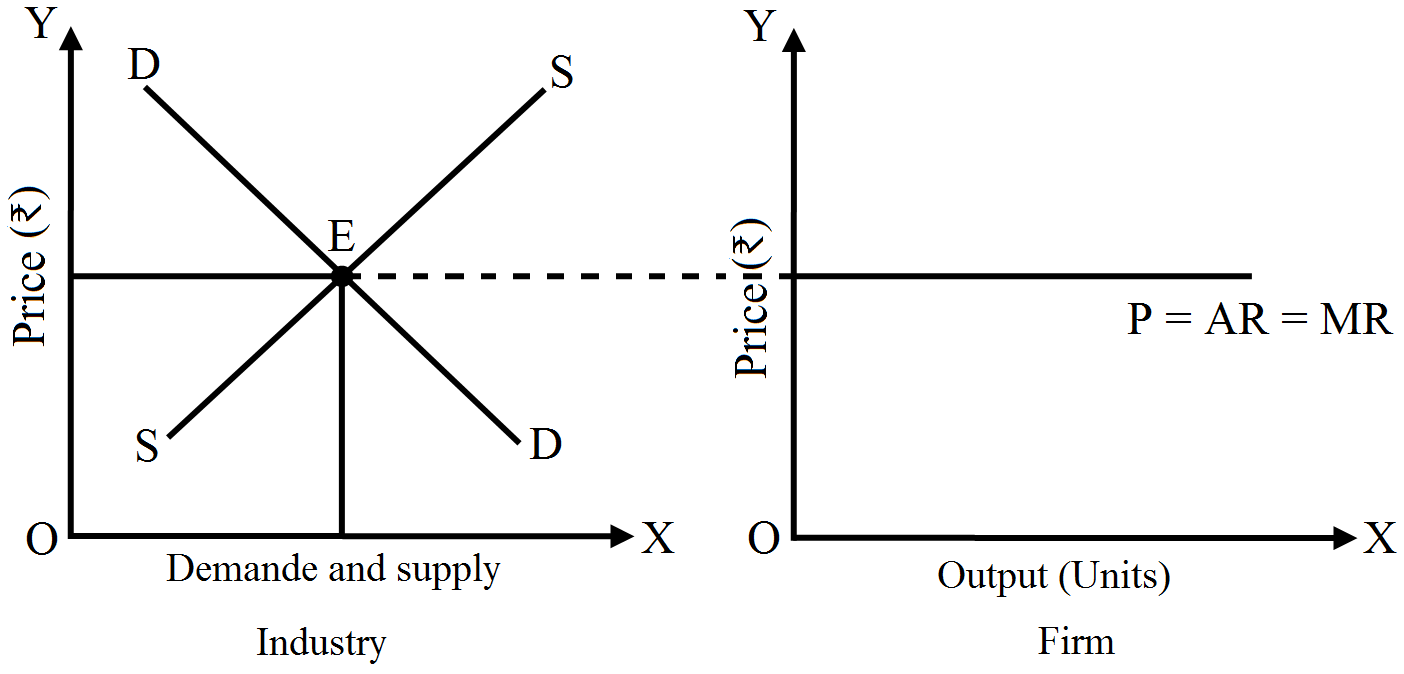
Why is AR always equal to MR for a competitive firm?
Answer

Under perfect competition, price is given to a firm as determined by the market forces of demand and supply in the industry. Constant price implies constant AR. Constant AR implies constant MR under perfect competition. So, AR = MR as shown in the diagram:

Need a full question paper?

Generate a complete, print-ready paper with questions like this in minutes — across 16+ boards, with answer keys.

Start Generating Free

Similar questions

A consumer consumes only two goods $X$ and $Y$. Marginal utility of each is $2$. The price per unit of $X$ and $Y$ is Re. $1$ and Rs. $2$ respectively. Is the consumer in equilibrium? What will be the further reaction of the consumer? Explain.
A producer starts a business by investing his own savings and hiring the labour. Identify implicit and explicit costs from this information. Explain.
Ice cream is sold for ₹ 30. Lakshmi who loves eating ice cream, has already eaten 3 ice creams. Her marginal utility from eating 3 ice cream is 90. Suppose, for her, MU of one rupee is 3. should she eat more ice creams or stop?
Consider a market where there are just two consumers and suppose their demands for the good are given as follows:
Calculate the market demand for the good.
p
$d_1$
$d_2$
$1$
$2$
$3$
$4$
$5$
$6$
$9$
$8$
$7$
$6$
$5$
$4$
$24$
$20$
$18$
$16$
$14$
$12$
Explain why an Indifference curve has a negative slope (i.e. IC slope downwards to the right).
OR
Why is an indifference curve negatively sloped? Explain.
What is meant by price rigidity, under oligopoly?
Complete the following indifference schedule of a consumer consuming bundles of two goods X and Y.
$Combination$
$Good ~X$
$Good ~Y$
$MRS_{XY}$
A
1
15
-
B
2
-
4 : 1
C
-
8
3 : 1
D
4
6
-
E
5
-
1 : 1
When is demand elastic?
For a data Lasperey's index number is 120 and fisher's index number is 125. Calculate Paasche's index number.
At a given price, there is excess demand for a good. Explain how the equilibrium price will be reached.
OR
Explain the sequence of changes that will take place when there is excess demand of the commodity.