Question
Why is electrical power required at all when the elevator is descending? Why should there be a limit on the number of passengers in this case?

Answer

When elevator is descending then it is not its free fall under gravity it descends with uniform speed. Power is required to decrease the velocity due to free fall.
Power of motor or system of an elevator is constant and a limited or specified power can stop the speed of freely falling of passenger along with elevator.

Need a full question paper?

Generate a complete, print-ready paper with questions like this in minutes — across 16+ boards, with answer keys.
Start Generating Free

Similar questions

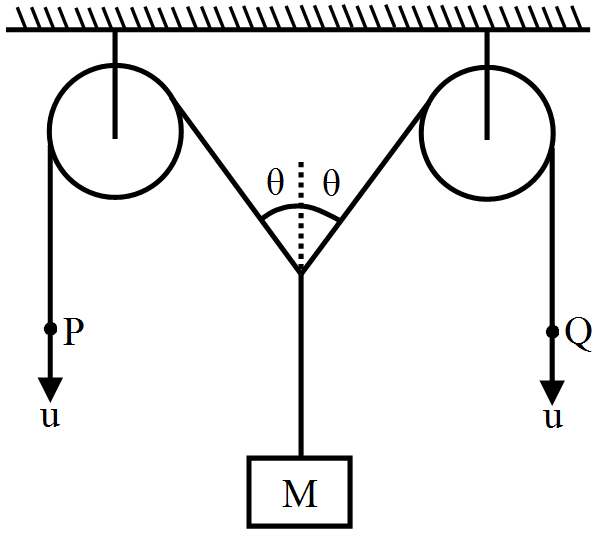
In the given arrangement, if the points P and Q move down with a velocity u, find the velocity of M?

Two small bodies of masses 2.00kg and 4.00kg are kept at rest at a separation of 2.0m. Where should a particle of mass 0.10kg be placed to experience no net gravitational force from these bodies? The particle is placed at this point. What is the gravitational potential energy of the system of three particles with usual reference level?
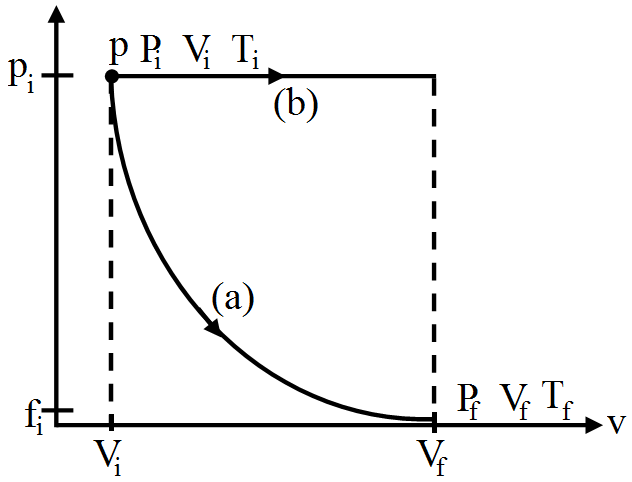
The initial state of a certain gas is (Pi , Vi , Ti ). It undergoes expansion till its volume becoms Vf . Consider the following two cases:
  1. The expansion takes place at constant temperature.
  2. The expansion takes place at constant pressure.
Plot the P-V diagram for each case. In which of the two cases, is the work done by the gas more?

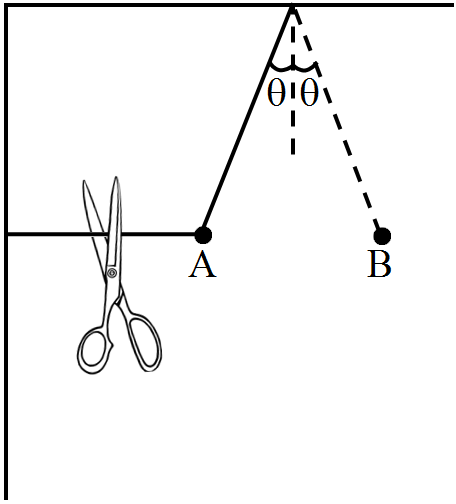
A ball is held at rest at position A in Fig., by two light strings. The horizontal string is cut and the ball starts swinging as a pendulum. Point B is the farthest to the right where the ball goes as it swings back and forth. What is the ratio of the tension in the supporting string in position B to its value at A before the horizontal string was cut?A ball is held at rest at position A in Fig., by two light strings. The horizontal string is cut and the ball starts swinging as a pendulum. Point B is the farthest to the right where the ball goes as it swings back and forth. What is the ratio of the tension in the supporting string in position B to its value at A before the horizontal string was cut?

In a car race, car A takes a time t seconds less than the car B and passes the finishing point with a velocity v more than that of the car B. If the cars start from rest and travel with constant acceleration a1 and a2 respectively, show that $\text{v}=\text{t}\sqrt{\text{a}_1\text{a}_2}.$
Find an expression for the orbital velocity of a satellite revolving around the earth in a circular orbit at a height h above the surface of earth.
Show dimensionally that the frequency n of transverse waves in a string of length / and mass, per unit length z under a tension T is given by n = $\frac{\text{K}}{l}\sqrt{\frac{\text{T}}{\text{m}}}.$
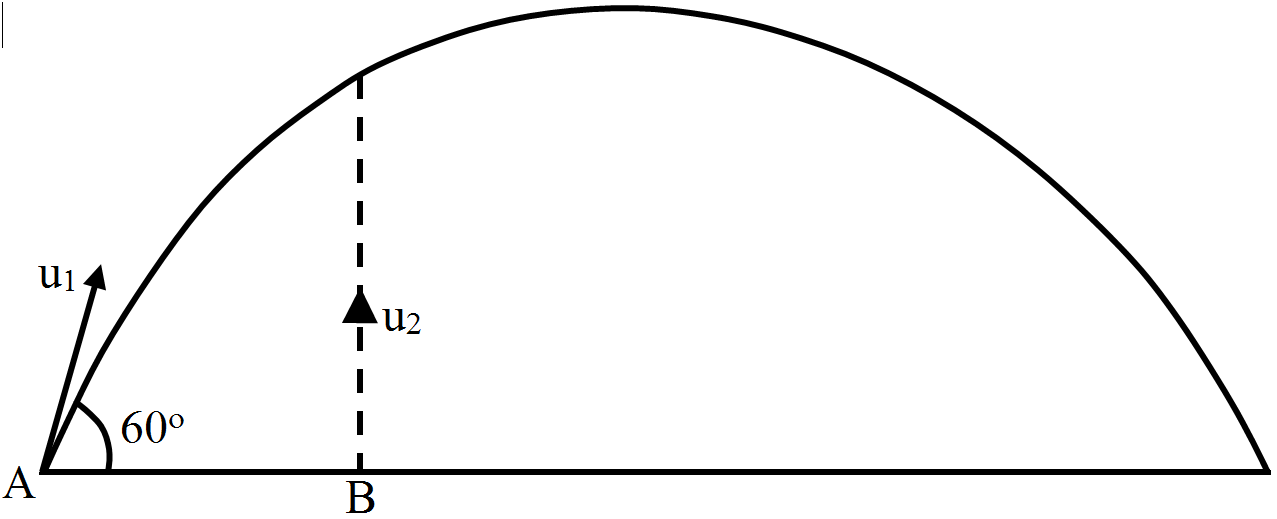
A body is projected with the velocity u1 from the point A as shown in figure. At the same time another body is projected vertically upwards with the velocity u2 from the point B. What should be the value of $\frac{\text{u}_1}{\text{u}_2}$ for both the bodies to collide?

If earth contracts to half its radius. What would be the length of the day?
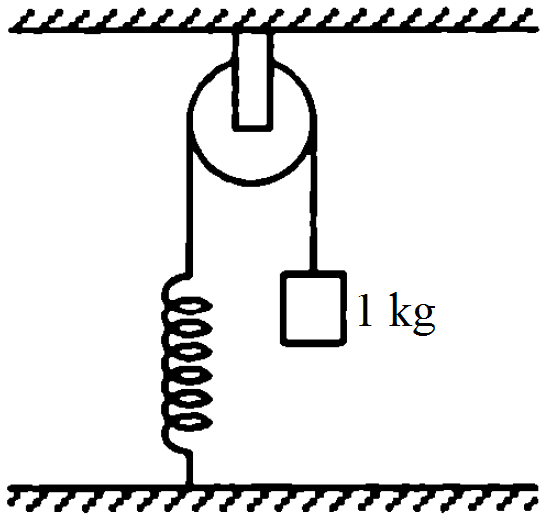
The pulley shown in figure has a radius of 20cm and moment of inertia 0.2kg-m2. The string going over it is attached at one end to a vertical spring of spring constant 50N/m fixed from below, and supports a 1kg mass at the other end. The system is released from rest with the spring at its natural length. Find the speed of the block when it has descended through 10cm. Take g = 10m/s2.