Question
Why is interference pattern not obtained on placing two coherent sources apart from each other at large distance.

Answer

Fringe width : $ W=D\lambda/d \Rightarrow W \propto 1/d. $
Hence, when distance between two coherent sources d is kept large fringe width will become very small. Therefore fringe will overlap each other hence interference pattern will not be obtained.

Need a full question paper?

Generate a complete, print-ready paper with questions like this in minutes — across 16+ boards, with answer keys.
Start Generating Free

Similar questions

The value of the Brewster angle for a transparent medium is different for lights of different colours.
A cylinder rolls on a horizontal plane surface. If the speed of the centre is 25m/s, what is the speed of the highest point?
The gravitational field in a region is given by $\text{E}=(2\hat{\text{i}}+3\hat{\text{i}})\text{N/kg}.$ Show that no work is done by the gravitational field when a particle is moved on the line 3y + 2x = 5.
Hint: If a line y = mx + c makes angle $\theta$ with the X-axis, m $=\tan\theta$
A load of 10kg is suspended by a metal wire 3m long and having a cross-sectional area 4mm2. Find.
  1. The stress.
  2. The strain and.
  3. The elongation. Young's modulus of the metal is 2.0 × 10N11N/ m2.
A ball is projected from a point on the floor with a speed of 15m/s at an angle of 60° with the horizontal. Will it hit a vertical wall 5m away from the point of projection and perpendicular to the plane of projection without hitting the floor? Will the answer differ if the wall is 22m away?
Describe briefly, with the help of a diagram, the role of the two important processes involved in the formation of a p-n junction.
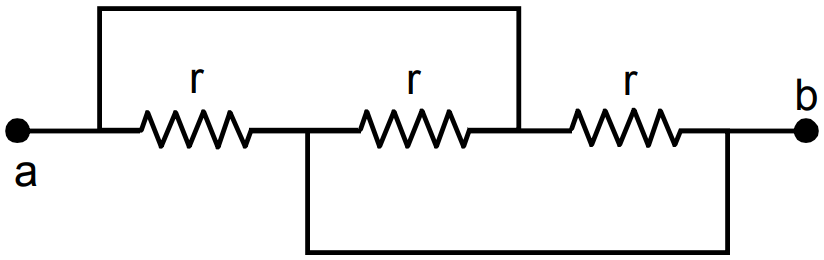
Find the equivalent resistance of the network shown in figure. between the points a and b.

A semiconductor has equal electron and hole concentration of 6 × 10⁸/m3. On doping with certain impurity, electron concentration increases to 9 × 10¹²/m3.
  1. Identify the new semiconductor obtained after doping.
  2. Calculate the new hole concentration.
The speed of sound as measured by a student in the laboratory on a winter day is 340m/s when the room temperature is 17°C. What speed will be measured by another student repeating the experiment on a day when the room temperature is 32°C?
A spherical conducting shell of inner radius r1 and outer radius r2 has a charge ‘Q’. A charge ‘q’ is placed at the centre of the shell.
  1. What is the surface charge density on the (i) inner surface, (ii) outer surface of the shell?
  2. Write the expression for the electric field at a point x > r2 from the centre of the shell.