Question
Why is there no dispersion in the light refracted through a rectangular glass slab?

Answer

It can be considered to be equivalent to two prisms in reverse way. In the case of a rectangular glass slab the rays of all colours combine together in the reverse prism. Hence, there is no dispersion.

Need a full question paper?

Generate a complete, print-ready paper with questions like this in minutes — across 16+ boards, with answer keys.
Start Generating Free

Similar questions

Define dielectric constant of a medium. What is the value of dielectric constant for a metal?
A circular coil of radius 2.0cm has 500 turns and carries a current of 1.0A. Its axis makes an angle of 30° with the uniform magnetic field of magnitude 0.40 T that exists in the space. Find the torque acting on the coil.
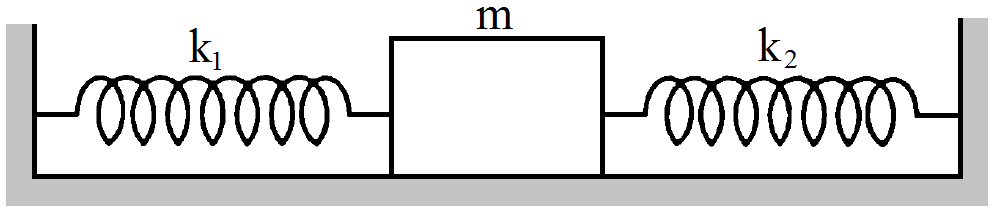
A block of mass m is attached to two unstretched springs of spring constants k1 and k2 as shown in figure. The block is displaced towards right through a distance x and is released. Find the speed of the block as it passes through the mean position shown.

Why is base band signal not transmitted directly? Give any two reasons.
The susceptibility of a magnetic material is –2.6 × 10⁻⁵. Identify the type of magnetic material and state its two properties.
If a constant potential difference is applied across a bulb, the current slightly decreases as time passes and then becomes constant. Explain.
A cylindrical metallic wire is stretched to increase its length by 5%. Calculate the percentage change in its resistance.
An electric field $\vec{\text{E}}=(\vec{\text{i}}20+\vec{\text{j}}30)\text{N}\text{C}^{-1}$ exists in the space. If the potential at the origin is taken to be zero, find the potential at (2m, 2m).
At room temperature (27.0°C) the resistance of a heating element is $100\ \Omega.$ What is the temperature of the element if the resistance is found to be $117\ \Omega,$ given that the temperature coefficient of the material of the resistor is $1.70\times10^{-4}\ ^\circ\text{C}^{-1}.$
A compound microscope forms an inverted image of an object. In which of the following cases it is kely to create difficulties?
  1. Looking at small germs.
  2. Looking at circular spots.
  3. Looking at a vertical tube containing some water.