- Abecause $NH_3$ can’t react with $H_2SO_4,\, P_2O_5$ and $CaCl_2$
- Bbecause $NH_3$ can’t react with Water
- Cbecause $NH_3$ can’t react with $C_6H_6$
- ✓because $NH_3$ react with $H_2SO_4,\, P_2O_5$ and $CaCl_2$
Generate a complete, print-ready paper with questions like this in minutes — across 16+ boards, with answer keys.
$\operatorname{cis}-\left[\mathrm{Cr}(\mathrm{ox})_2 \mathrm{Cl}_2\right]^{3-},\left[\mathrm{Co}(\mathrm{en})_3\right]^{3+}$
$\operatorname{cis}-\left[\mathrm{Pt}(\mathrm{en})_2 \mathrm{Cl}_2\right]^{2+}, \text { cis }-\left[\mathrm{Co}(\mathrm{en})_2 \mathrm{Cl}_2\right]^{+}$
$\text {trans }-\left[\mathrm{Pt}(\mathrm{en})_2 \mathrm{Cl}_2\right]^{2+}, \text { trans }-\left[\mathrm{Cr}(\mathrm{ox})_2 \mathrm{Cl}_2\right]^{3-}$
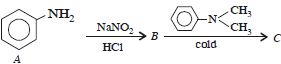
The structure of $C$ would be

Penta acetate of glucose $\xrightarrow[{\operatorname{Re} agent}]{{Tollen's}}$ $+\,ve$ test $(A)$
Penta acetate of glucose $\xrightarrow{{Benedicts}}$ $+\,ve$ test $(B)$
Penta acetate of glucose $\xrightarrow[{\operatorname{Re} agent}]{{Schiffs}}$ $-\,ve$ test $(C)$
Penta acetate of glucose $\xrightarrow{{NaHS{O_3}}}$ $-\,ve$ test $(D)$