Question
Why p-nitrophenol is a stronger acid than phenol ?

Answer

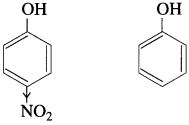
(1) In p-nitrophenol, nitro group $\left( NO _2\right)$ is an electron withdrawing group present at para position which enhances the acidic strength ($ -1$ effect). The $O - H$ bond is under strain and release of proton $\left( H ^{+}\right)$becomes easy. Further pnitrophenoxide ion is more stabilised due to resonance.
(2) Since the absence of electron withdrawing group (like $NO _2$ ) in phenol at ortho and para position, the acidic strength of phenol is less than that of
p-nitrophenol.​​​​​​​

Image

Need a full question paper?

Generate a complete, print-ready paper with questions like this in minutes — across 16+ boards, with answer keys.
Start Generating Free

Similar questions

What is osmotic pressure? How will you determine molar mass of solute from osmotic pressure?
What are the characteristics of rate constant?
Define 'Cryoscopic constant'. Derive the relation between elevation of boiling point and molar mass of solute.
Distinguish between $– S_N1$ and $S_N2$ mechanism of substitution reaction ?
The half-life of a first order reaction is $900 min$ at $820 K$. Estimate its half-life at $720 K$ if the energy of activation of the reaction is $250 kJ mol ^{-1}\left(1.464 \times 10^5 mm \right)$.
Aluminium having atomic mass $27 g mol ^{-1}$ crystallises in face centred packed cubic crystal. Find the number of $Al$ atoms in $10 g$ aluminium. How many unit cells will be present in it?
Write the reaction showing major and minor products formed on heating butan-2-ol with concentrrated sulphuric acid.
(1) Compare the $pK_a$​​​​​​​ values and arrange the following in an increasing order of acid strength. $CI_3CCOOH, ClCH_2COOH, CH_3COOH, Cl_2CHCOOH$
(2) Draw structures of conjugate bases of monochloroacetic acid and dichloroacetic acid. Which one is more stabilized by – $1$ effect?
For the reaction,
$
3 I _{(a q)}^{-}+ S _2 O _{8(a q)}^{2-} \longrightarrow I _{3( aq )}^{-}+2 S O _{4( aq )}^{2-}
$
Calculate (a) the rate of formation of $I _3^{-}$,
(b) the rates of consumption of 1 and $S _2 O$ and (c) the overall rate of reaction if the rate of formation of $SO _4^{2-}$ is 0.022 moles $dm ^{-3} sec ^{-1}$.
Define the term Co-ordination isomer.